
2.1
Antepartum Haemorrhage
Obstetrics & Gynaecology Protocols, Version 3.0, 2017. Chapter 2, Labour Ward.
Clinical description
APH refers to vaginal bleeding that occurs at ≥ 28 wks gestation at any time prior to delivery.
Management (initial actions)
- Immediately call for help, urgently mobilize available staff and initiate resuscitation
- Evaluate patient’s general condition quickly, including vital signs (VS)
- Obtain IV access with 2 large-bore cannulae (i.e. 16G)
- Place foley catheter to monitor Input and Output
- Maintain SBP > 100 mm Hg and urine output (UOP) > 30 ml/hr (give minimum of 0.9% NS 1 L
rapid infusion while awaiting blood products)
- Send blood for FBC, U&Es, Cr, clotting time and X-match
- If heavy bleeding, order at least 2 units each of PRBC, FFP and platelets or 2 units of whole
blood.
- Ultrasound to assess fetal condition
- Ultrasound to rule-out placenta praevia and/or evaluate placenta for possible abruption where
present, noting that abruption is a clinical diagnosis using the grading criteria below. Further management depends on the aetiology of APH
- If Rh negative, refer to section on Alloimmunization in Pregnancy
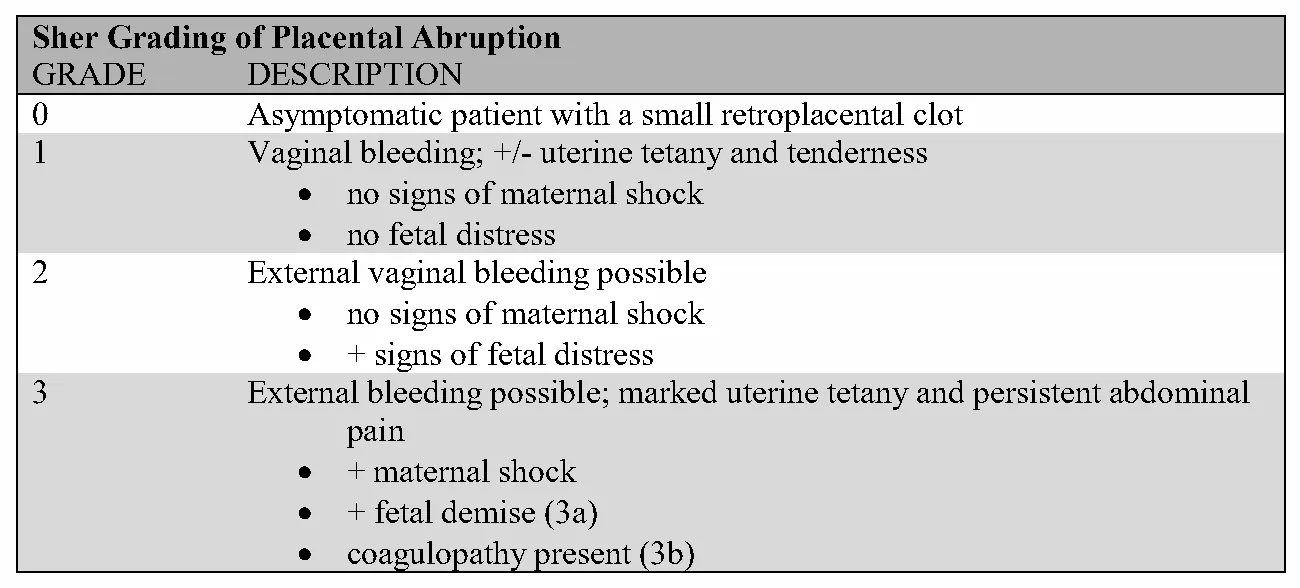
No digital vaginal examination until placenta praevia is excluded Sher Grading of Placental Abruption 0 Asymptomatic patient with a small retroplacental clot 1 Vaginal bleeding; +/- uterine tetany and tenderness
- no signs of maternal shock
- no fetal distress
2 External vaginal bleeding possible
- no signs of maternal shock
- + signs of fetal distress
3 External bleeding possible; marked uterine tetany and persistent abdominal pain
- + maternal shock
- + fetal demise (3a)
- coagulopathy present (3b)
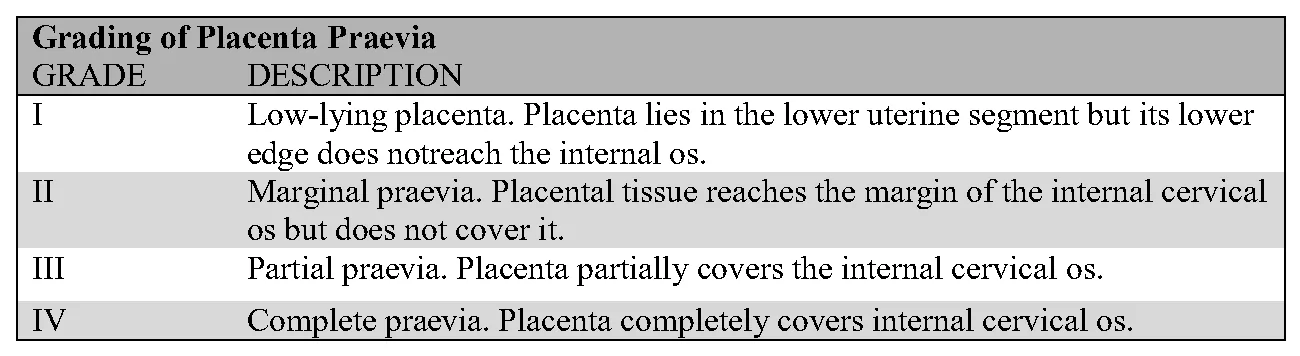
Grading of Placenta Praevia I Low-lying placenta. Placenta lies in the lower uterine segment but its lower edge does notreach the internal os.
II Marginal praevia. Placental tissue reaches the margin of the internal cervical os but does not cover it.
III Partial praevia. Placenta partially covers the internal cervical os.
IV Complete praevia. Placenta completely covers internal cervical os.
Clinical description
*Grade 1 and 2 are Placenta Praevia Minor, whereas Grade 3 and 4 are Placenta Praevia Major.
Clinical description
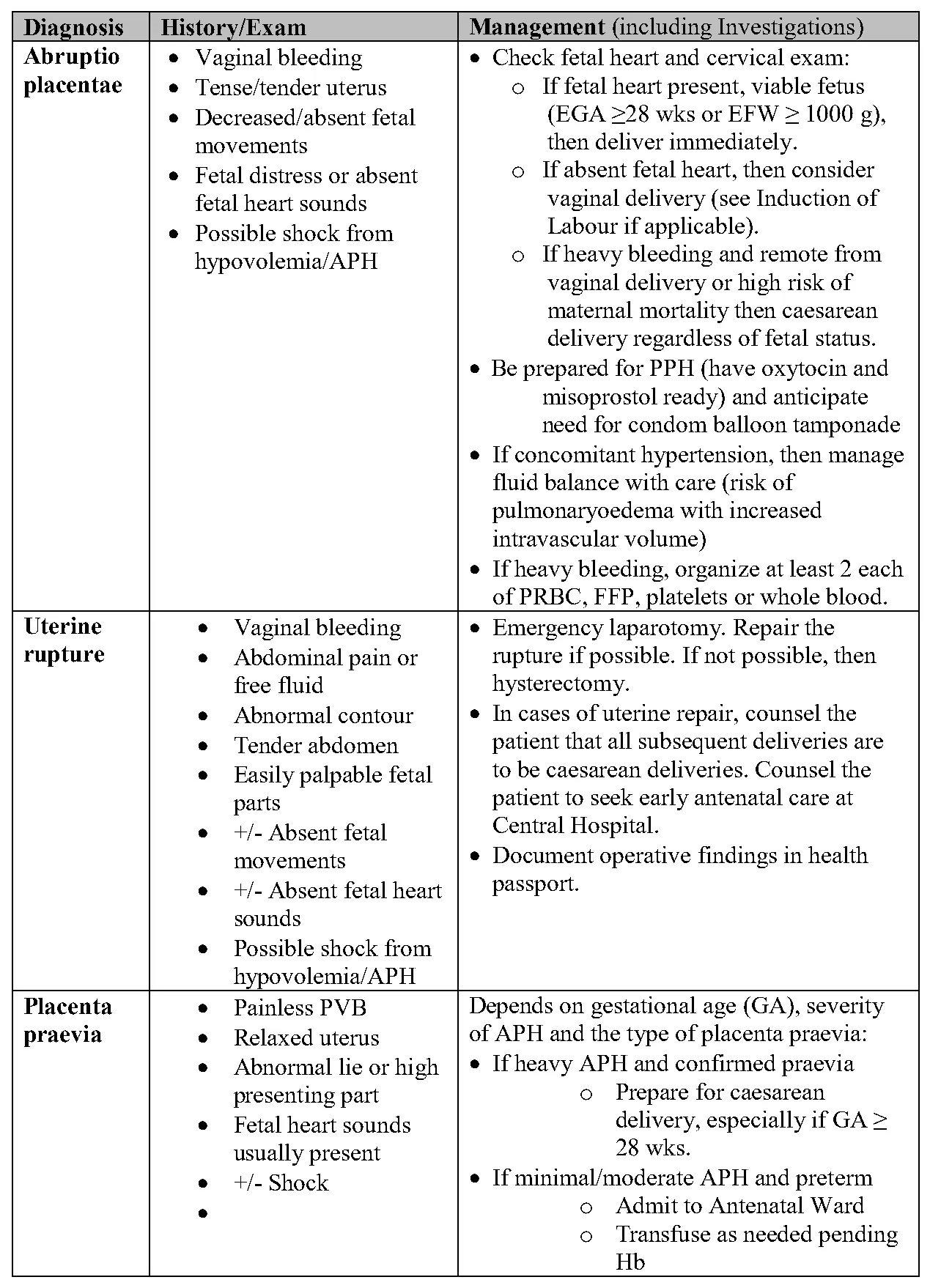
Diagnosis History/Exam Management (including Investigations) Abruptio • Vaginal bleeding • Check fetal heart and cervical exam:
placentae • Tense/tender uterus o If fetal heart present, viable fetus
- Decreased/absent fetal (EGA ≥28 wks or EFW ≥ 1000 g),
movements then deliver immediately.
- Fetal distress or absent o If absent fetal heart, then consider
fetal heart sounds vaginal delivery (see Induction of Labour if applicable).
- Possible shock from
- If heavy bleeding and remote from
hypovolemia/APH vaginal delivery or high risk of maternal mortality then caesarean delivery regardless of fetal status.
- Be prepared for PPH (have oxytocin and
misoprostol ready) and anticipate need for condom balloon tamponade
- If concomitant hypertension, then manage
fluid balance with care (risk of pulmonaryoedema with increased intravascular volume)
- If heavy bleeding, organize at least 2 each
of PRBC, FFP, platelets or whole blood.
Uterine • Vaginal bleeding • Emergency laparotomy. Repair the rupture • Abdominal pain or rupture if possible. If not possible, then free fluid hysterectomy.
- Abnormal contour • In cases of uterine repair, counsel the
- Tender abdomen patient that all subsequent deliveries are
- Easily palpable fetal to be caesarean deliveries. Counsel the
parts patient to seek early antenatal care at Central Hospital.
- +/- Absent fetal
movements • Document operative findings in health passport.
- +/- Absent fetal heart
sounds
- Possible shock from
hypovolemia/APH Placenta • Painless PVB Depends on gestational age (GA), severity praevia • Relaxed uterus of APH and the type of placenta praevia:
- Abnormal lie or high • If heavy APH and confirmed praevia
presenting part o Prepare for caesarean
- Fetal heart sounds delivery, especially if GA ≥
usually present 28 wks.
- +/- Shock • If minimal/moderate APH and preterm
- Admit to Antenatal Ward
- Transfuse as needed pending
Hb
Clinical description
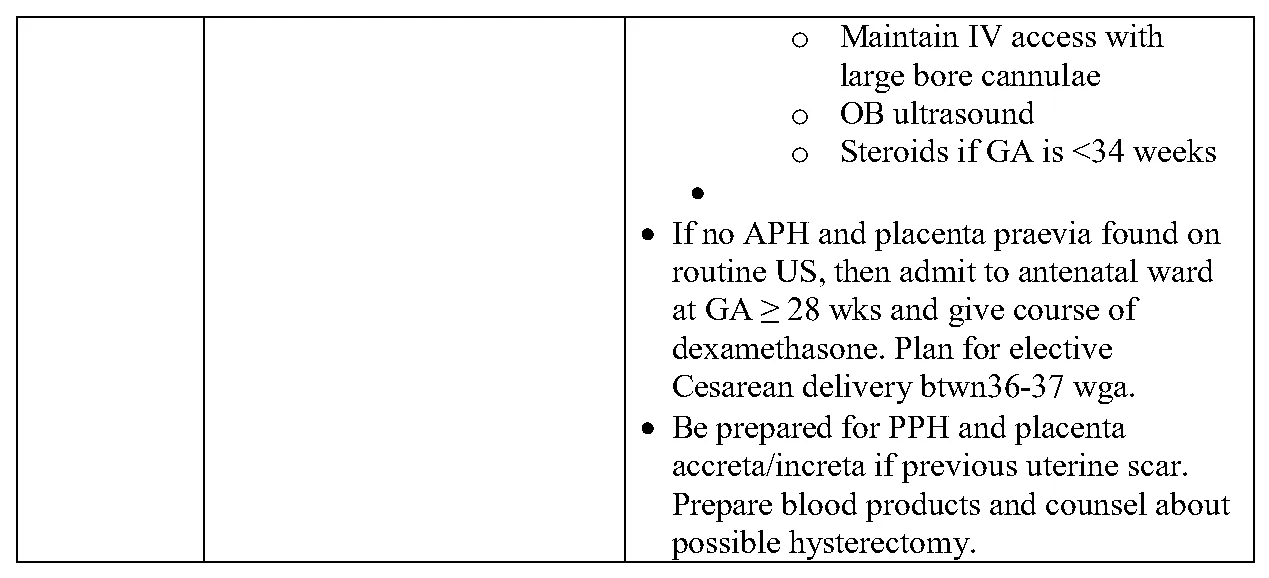
- Maintain IV access with
large bore cannulae
- OB ultrasound
- Steroids if GA is <34 weeks
- If no APH and placenta praevia found on
routine US, then admit to antenatal ward at GA ≥ 28 wks and give course of dexamethasone. Plan for elective Cesarean delivery btwn36-37 wga.
- Be prepared for PPH and placenta
accreta/increta if previous uterine scar.
Prepare blood products and counsel about possible hysterectomy.
Clinical description
Induction of labour is accomplished with a variety of interventions that ripen the cervix and initiate labour.
Indications include unfavourable Bishop score < 6 with any of the following: post-term, eclampsia, severe preeclampsia, mild preeclampsia at term, PROM > 24 hrs at term or PPROM > 34 weeks EGA, and IUFD.
Contraindications include:
- Poor condition of the mother (very ill and needs to be delivered sooner)
- Abnormal lie and presentation (see Malpresentation, Abnormal Position, and Transverse Lie)
- Umbilical cord prolapse
- Obstructed labour
- Features suggestive of a compromised baby (i.e., non-reassuring fetal heart tracing)
- Placenta praevia
- Limb deformities with contracted pelvis
- Previous VVF repair
- Previous transfundal uterine surgery
- Active genital herpes infection
Signs and symptoms
History/Exam/Investigations Clearly document the indication for the induction and verify the gestational age as accurately as possible (earliest available US in agreement with LMP). Do not rely on fundal height.
Confirmation of a term gestation:
- US measurement at less than 20 wks supporting GA of 39 wks or greater
- Fetal heart tones documented as present by Doppler for 30 wks
- It has been 36 weeks since a positive pregnancy test
Treatment
Calculate the Bishop score to determine if cervix needs ripening or not Cervix Score 0 1 2 3 Position Posterior Midposition Anterior - Consistency Firm Medium Soft -
Clinical description
Effacement > 4 cm 3-4 cm 1-2 cm 0 cm Dilation Closed 1-2 cm 3-4 cm ≥ 5 cm Station of fetal -3 -2 -1 +1, +2 head Methods to ripen the cervix for unfavourable cervix (Bishop Score <6) Misoprostol (see below) and/or Foley catheter inflated with 40-60 ml of water *DO NOT GIVE MISOPROSTOL IF ≥ 28 WKS + PREVIOUS CESAREAN DELIVERY
- If second trimester gestation (<28 weeks), then see Abortion protocol
- If third trimester gestation (including IUFD), then misoprostol:
- Dissolve misoprostol 200 mcg tablet into 20 mL of water. Give 2.5 mL (25 mcg) of solution PO
every 2 hours.
OR
- 25 mcg PV every 4 hrs, max of 6 doses.
- 50 mcg PV every 6 hrs, max of 4 doses, for induction of labour.
If not in active labor after 4 doses and if fetal status is reassuring, rest patient for 24 hours and restart induction, or try an alternative agent such as a foley bulb.
- If CTG or Moyo available, perform a NST before initiating any method of induction to confirm there is a
reassuring pattern and no sign of fetal distress.
- Monitor all patients for uterine tachysystole throughout the induction. (> 5 contractions within a 10-minute
period averaged over 30 minutes.)
- In the event of tachysystole, perform a NST to assess fetal wellbeing and place IV.
- Once cervix is ripened, continue with augmentation of labour or with methods of induction for favourable
cervix (see below).
Methods of induction for favourable cervix (Bishop score ≥ 6)
- Amniotomy alone
- Oxytocin alone
- Amniotomy and oxytocin if no contraindications
- Avoid prolonged duration of ruptured membranes in HIV-infected patients.
- If membranes have already ruptured, oxytocin is as effective in labor induction as cervical ripening.
Methods of induction of labour in previous cesarean delivery
- Start induction only with approval of Consultant
- DO NOT USE misoprostol if ≥ 28 wks GA
- Consider amniotomy
- Consider foley catheter +/- oxytocin for cervical ripening
Methods of induction of labour in pre-eclampsia with severe features, signs of IUGR, or any other concern for the fetus that still allows for IOL and does not require cesarean delivery:
- Consider foley bulb induction rather than misoprostol
Tables and figures


Check doses against the printed guideline and your clinical judgement before treating a patient. Spotted an error? Report it from the contact links below.
Need this without data?
The app holds every guideline on your device, with calculators, bookmarks and notes.