
2.21
Shoulder Dystocia
Obstetrics & Gynaecology Protocols, Version 3.0, 2017. Chapter 2, Labour Ward.
Clinical description
Shoulder dystocia is an obstetric emergency in which descent of the anterior shoulder is obstructed by the symphysis pubis and thus the shoulders and body of the infant fail to deliver after the head has delivered.
Previous history of shoulder dystocia, macrosomia, maternal diabetes, maternal obesity, operative vaginal delivery, and protracted second stage are risk factors. However, the majority of cases of shoulder dystocia occur in low risk deliveries.
Shoulder dystocia is not accurately predictable or preventable.Thus, the clinician should be prepared for shoulder dystocia at all deliveries.
Signs and symptoms
Birth attendants should routinely look for the signs of shoulder dystocia:
- Difficulty with delivery of the face and chin
- Retraction of fetal head against the maternal perineum (turtle sign)
- Failure of restitution of the fetal head
- Failure of the shoulders to descend
After 6-minute head-to-body interval there is increased risk of neonatal depression, acidosis, asphyxia, central nervous system damage, and death.
Treatment
- Start timing from when shoulder dystocia is diagnosed
- Call for help – registrar should be present along with interns and midwives
- Notify consultant on call
- Notify pediatricians, ideally they should come to the delivery
- Notify anesthetist
- Do not use fundal pressure (this worsens impaction of the fetal shoulder and increases the risk of uterine rupture)
- Tell patient to stop pushing and to push only when you instruct them
- Consider episiotomy only if it will make internal maneuvers easier
- Catheterization
- Start with McRobert’s position- flexion and abduction of the maternal hips, positioning the maternal thighs on her
abdomen.
- This rotates the symphysis pubis and flattens the lumbar lordosis, often freeing the impacted shoulder.
- Suprapubic pressure can be employed together with the McRoberts’ manoeuvre- using palm or fist superior to pubic
symphysis to push anterior shoulder down towards fetal chest.
- Apply constant moderate downward traction on the fetal head in alignment with the fetal cervico-thoracic spine at a
vector 25-45 degrees below the horizontal plane when the woman is in a lithotomy position.
- Avoid excessive traction or lateral traction on the fetal head.
- If this fails, attempt other methods:
- Delivery of the posterior shoulder – flex the posterior arm over the fetal chest using two fingers (to avoid
fracture of the humerus) to allow delivery of the posterior arm.
- Rubin’s maneuver - insert one hand in the vagina posteriorly or anteriorly along the dorsal aspect of the
fetal shoulder and rotate the shoulder inward (adduction) about 30° until the shoulders lie in the oblique diameter of the pelvis
- Wood’s screw maneuver - the posterior shoulder may be rotated forward, through a 180-degree arc, and
passed under the pubic ramus as in turning a screw
- Barnum’s maneuver - Slide the hand along the dorsal aspect of the humerus and press it against the fetal
chest, the clinician then palpates the elbow.
If the elbow is already flexed, the operator grasps the fetal forearm and wrist and sweeps the forearm over the chest and across the infant’s face, extending the arm at the elbow and shoulder to deliver it first.
- Gaskin maneuver- turn patient on all fours with back arched
- Other more traumatic methods - a last resort:
- Zavanelli's maneuver, which involves pushing the fetal head back in with performing a cesarean section. or
internal cephalic replacement followed by Cesarean section
- Intentional fetal clavicular fracture -reduces the diameter of the shoulder girdle that requires to pass through
the birth canal.
Clinical description
- Maternal symphysiotomy, which makes the opening of the birth canal laxer by breaking the connective
tissue between the two pubes bones facilitating the passage of the shoulders.
- Abdominal rescue, described by O'Shaughnessy, where a hysterotomy facilitates vaginal delivery of the
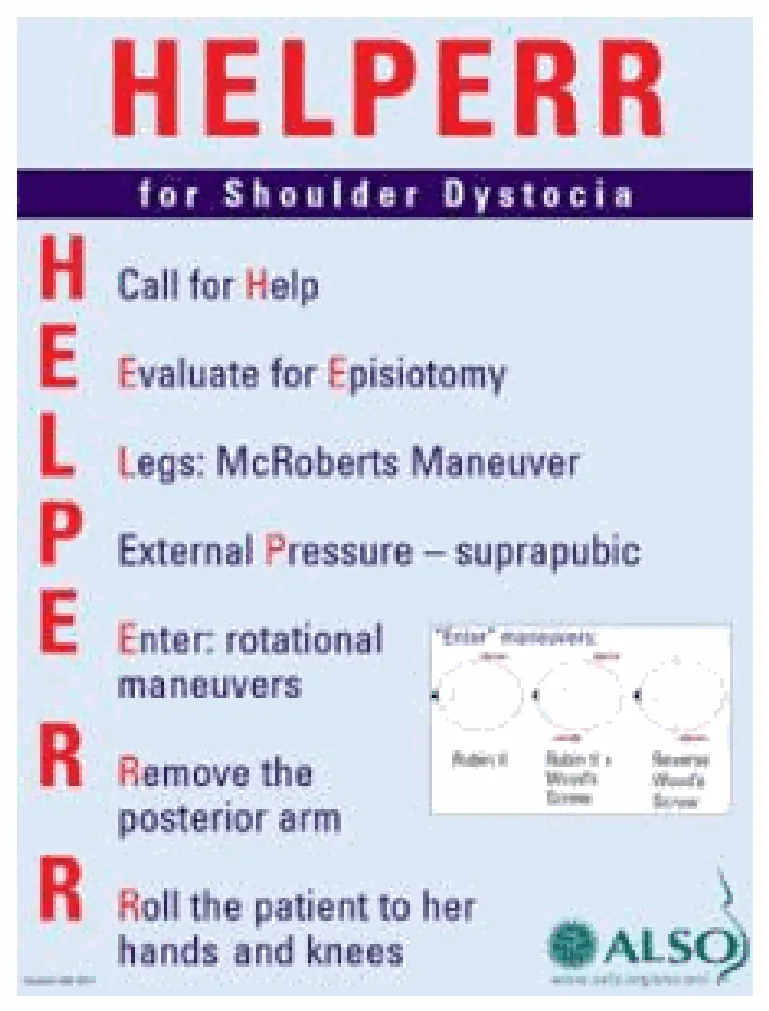
impacted shoulder Mnemonic for shoulder dystocia:
Complications
- Maternal:
- Postpartum hemorrhage (11%)
- High degree lacerations (4th degree laceration in ~4% cases)
- Vaginal lacerations
- Uterine rupture
- Pubic symphysis separation
- Fetal:
- ~5% permanent injury rate
- Up to 40% of cases have initial brachial plexus injury but 80-90% recover
- Clavical fracture
- Humerus fracture
- Increased risk of hypoxemic ischemic encephalopathy and death
Tables and figures
Check doses against the printed guideline and your clinical judgement before treating a patient. Spotted an error? Report it from the contact links below.
Need this without data?
The app holds every guideline on your device, with calculators, bookmarks and notes.