
2.15
Perineal Lacerations
Obstetrics & Gynaecology Protocols, Version 3.0, 2017. Chapter 2, Labour Ward.
Clinical description
Perineal lacerations may be sustained during vaginal delivery and should be repaired immediately, usually following delivery of the placenta.
If repair is delayed > 24hrs, then wet to dry dressing/sitzbaths with weekly followup to check for infection, repair as an outpatient procedure 6 week postpartum.
The degree of the laceration is defined by its depth and involvement of the anal sphincter.
- First degree (1 ̊) - limited to superficial perineal skin or vaginal mucosa. Perineal muscles remain intact.
- Second degree (2 )̊ - extends into the perineal body muscles but does not involve the anal sphincter.
- Third degree (3 )̊ - involves anal sphincter but does not compromise the rectal mucosa
- 3a: Less than 50% of external anal sphincter (EAS) thickness torn.
- 3b: More than 50% of EAS thickness torn.
- 3c: Both EAS and internal anal sphincter (IAS) torn.
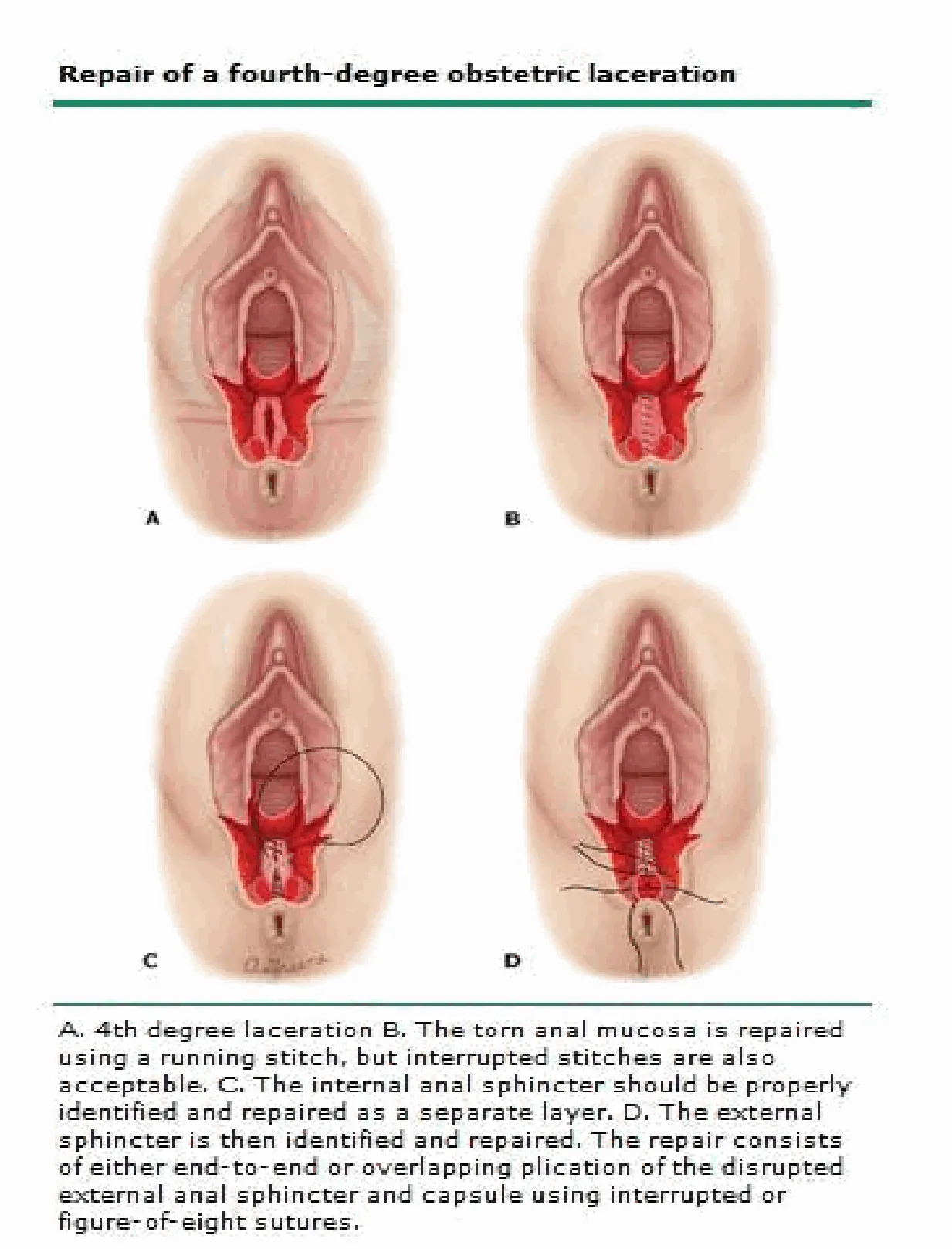
- Fourth degree (4 ̊) - interrupts the rectal mucosa.
Signs and symptoms
History/Exam/Investigations Assess extent of bleeding and injury to perineum, vagina, and anorectum by visually and digitally inspecting the injury.If exam at bedside is difficult, then do EUA in OT Management (3 ̊/4 ̊ laceration)
- Prophylactic Ceftriaxone 1 g IV and Metronidazole 500 mg IV 30 min before the procedure if 3 ̊/4 ̊ laceration
- Lithotomy position, adequate lighting, assistance with retraction
- Clean perineum with antiseptic solution
- Pain control: regional or sedation/GA
- Procedure for 3 ̊/4 ̊ laceration repair (note: sutures listed are suggestions)
- Close rectal and anal mucosa (4 ̊) with continuous (nonlocking) or interrupted sutures of 3-0 or 4-0 Vicryl
(braided polyglactin) if available on round body needle, starting from apex
- Repair IAS muscle as a separate layer with fine suture size such as 3-0 PDS or 3-0 Vicryl
- Reconstruct torn ends of EAS with interrupted stitches of 2-0 Vicryl. Use Allis clamps to grasp the two
severed ends. May use an end-to-end or overlapping technique.
- Repair perineal muscles with 2-0 Vicryl
- Repair vaginal epithelium and perineal skin
Post-procedure care
- Sitzbaths up to TDS
- Metronidazole 400 mg PO TDS for 5-7 days (4th degree)
- Soft diet and stool softeners for 3-4 weeks
- Pelvic floor exercises
Episiotomy Breakdown/Dehiscence Signs: Fever, wound tenderness, purulent discharge, typically occurring 6-8 days following delivery Management: Aggressive wound care including debridement and irrigation, Sitz baths. Once wound is free of exudate and is covered with pink granulation tissue, with no signs of infection, early secondary repair can be attempted.
Clinical description
Reference: UpToDate
Tables and figures
Check doses against the printed guideline and your clinical judgement before treating a patient. Spotted an error? Report it from the contact links below.
Need this without data?
The app holds every guideline on your device, with calculators, bookmarks and notes.