
2.19
Premature Rupture Of Membranes (PROM)
Obstetrics & Gynaecology Protocols, Version 3.0, 2017. Chapter 2, Labour Ward.
Clinical description
Premature rupture of membranes (PROM) refers to draining of amniotic fluid before the onset of labour. Preterm PROM (PPROM) is associated with significant maternal and neonatal morbidity and mortality. Spontaneous rupture of membranes > 24 wks gestation complicates 2-3% of pregnancies.
Signs and symptoms
History Continuous draining of fluid Exam Sterile speculum reveals fluid in the vaginal vault and/or fluid passing per os
- Avoid a digital examination, especially if PPROM
Investigations USS may show low liquor volume
Treatment
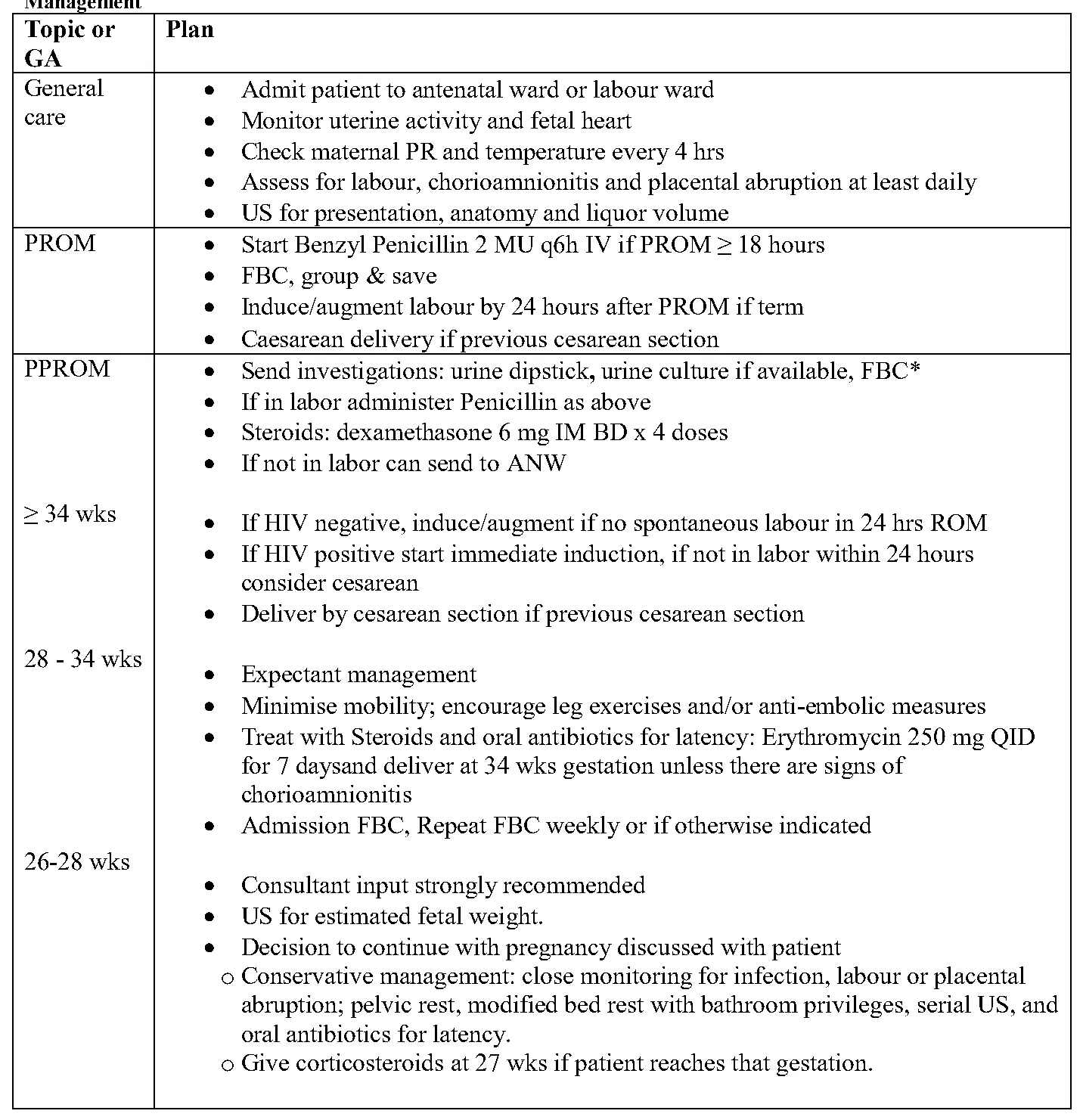
Topic or Plan GA General • Admit patient to antenatal ward or labour ward care • Monitor uterine activity and fetal heart
- Check maternal PR and temperature every 4 hrs
- Assess for labour, chorioamnionitis and placental abruption at least daily
- US for presentation, anatomy and liquor volume
PROM • Start Benzyl Penicillin 2 MU q6h IV if PROM ≥ 18 hours
- FBC, group & save
- Induce/augment labour by 24 hours after PROM if term
- Caesarean delivery if previous cesarean section
PPROM • Send investigations: urine dipstick, urine culture if available, FBC*
- If in labor administer Penicillin as above
- Steroids: dexamethasone 6 mg IM BD x 4 doses
- If not in labor can send to ANW
≥ 34 wks
- If HIV negative, induce/augment if no spontaneous labour in 24 hrs ROM
- If HIV positive start immediate induction, if not in labor within 24 hours
consider cesarean
- Deliver by cesarean section if previous cesarean section
28 - 34 wks
- Expectant management
- Minimise mobility; encourage leg exercises and/or anti-embolic measures
- Treat with Steroids and oral antibiotics for latency: Erythromycin 250 mg QID
for 7 daysand deliver at 34 wks gestation unless there are signs of chorioamnionitis
- Admission FBC, Repeat FBC weekly or if otherwise indicated
26-28 wks
- Consultant input strongly recommended
- US for estimated fetal weight.
- Decision to continue with pregnancy discussed with patient
- Conservative management: close monitoring for infection, labour or placental
abruption; pelvic rest, modified bed rest with bathroom privileges, serial US, and oral antibiotics for latency.
- Give corticosteroids at 27 wks if patient reaches that gestation.
Clinical description
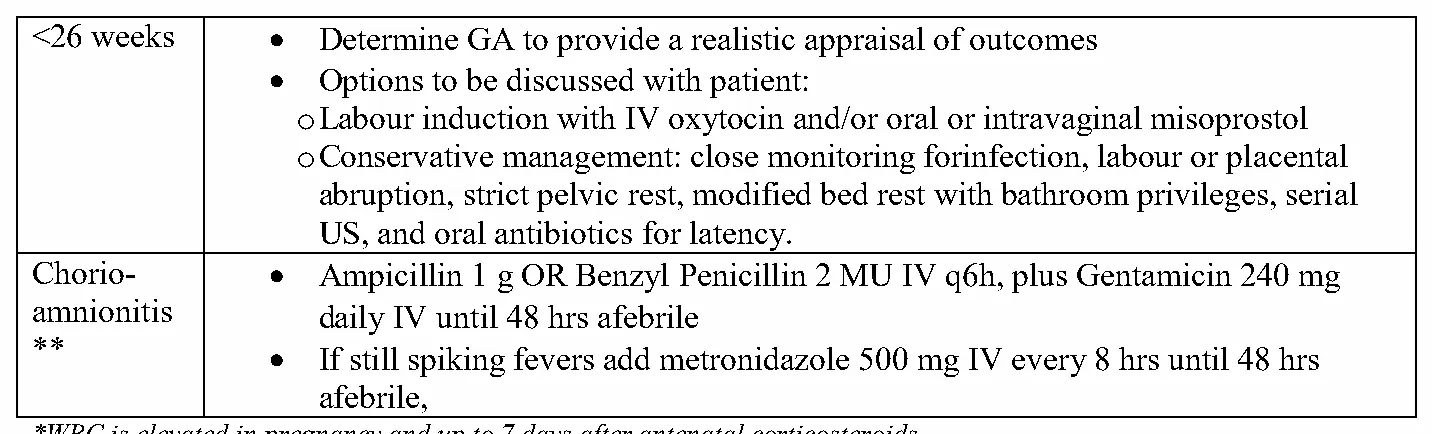
<26 weeks • Determine GA to provide a realistic appraisal of outcomes
- Options to be discussed with patient:
- Labour induction with IV oxytocin and/or oral or intravaginal misoprostol
- Conservative management: close monitoring forinfection, labour or placental
abruption, strict pelvic rest, modified bed rest with bathroom privileges, serial US, and oral antibiotics for latency.
Chorio- • Ampicillin 1 g OR Benzyl Penicillin 2 MU IV q6h, plus Gentamicin 240 mg amnionitis daily IV until 48 hrs afebrile **
- If still spiking fevers add metronidazole 500 mg IV every 8 hrs until 48 hrs
afebrile, *WBC is elevated in pregnancy and up to 7 days after antenatal corticosteroids **Signs of chorioamnionitis include: maternal tachycardia, maternal fever, abdominal tenderness, foul vaginal discharge, and WBC > 16,000
Clinical description
Preterm labour is defined as onset of contractions that cause progressive cervical dilation at < 37 wks gestation.
It complicates 10-12% of all pregnancies and is associated with significant neonatal morbidity and mortality, especially between 24-34 wks gestation.
Signs and symptoms
History Risk factors include:
- multiple gestation
- polyhydramnios
- acute local or systemic inflammation (eg. appendicitis, STIs, UTI and/or pyelonephritis)
- antepartum haemorrhage
- placental abruption
- uterine anomalies
- cervical insufficiency
- previous preterm delivery
- tobacco and illegal drug use
- lower socioeconomic status
- extremes of age
- poor nutrition
- poor or lack of antenatal care
ExamPresence of contractions with cervical dilation and effacement on VE Investigations Transvaginal Ultrasound for cervical length (short cervix ≤ 2.5 cm)
- Not for patients with pre-labour rupture of membranes!
Non-pharmacological
- Screen and treat asymptomatic bacteriuria/urine microscopy (previous preterm birth)
- If previous preterm birth and current singleton gestation, then treat with hydroxyprogesterone acetate 250mg
(Romero R, Nicolaides KH, et al 2016) IM every week at 16-36 weeks if available
- Interventions with inconsistent evidence – treatment of asymptomatic bacterial vaginosis, cervical cerclage
- Offer a choice of either prophylactic vaginal progesterone or prophylactic cervical cerclage to women with:
- A history of spontaneous preterm birth or mid-trimester loss between 16+0 and 34+0 weeks of pregnancy
and
- in whom a transvaginal ultrasound scan has been carried out between 16+0 and 24+0 weeks of pregnancy
that reveals a cervical length of < 25 mm.
- Discuss the benefits and risks of prophylactic progesterone and cervical cerclage with the woman and take her
preferences into account.
- Consider prophylactic cervical cerclage for women in whom a transvaginal ultrasound scan has been carried out
between 16+0 and 24+0 weeks of pregnancy that reveals a cervical length of < 25 mm and who have either:
Clinical description
- Had PPROM in a previous pregnancy
or
- A history of cervical trauma
Established preterm labor
- Monitor fetal heart rate and contractions
- IV line with NS at maintenance rate
- Send investigations if available: FBC, urinalysis / urine dipsticks, speculum exam to check for abnormal discharge,
- Do a wet prep/mount fortrichomonas and bacterial vaginosis
- US for presentation, AFI, placental location, EFW, EGA and anatomy
- Group B streptococcus prophylaxis
- Treat with penicillin IV (erythromycin if allergy to penicillin)
- Steroids for decreased risk of respiratory distress syndrome (RDS), necrotizing enterocolitis (NEC) and
intraventricular haemorrhage (IVH)
- Treat at 28-34 wks gestation unless fetal lung maturity is confirmed
- Betamethasone 12 mg IM every 24 hrs x 2 doses; or
- Dexamethasone 6 mg IM every 12 hrs x 4 doses
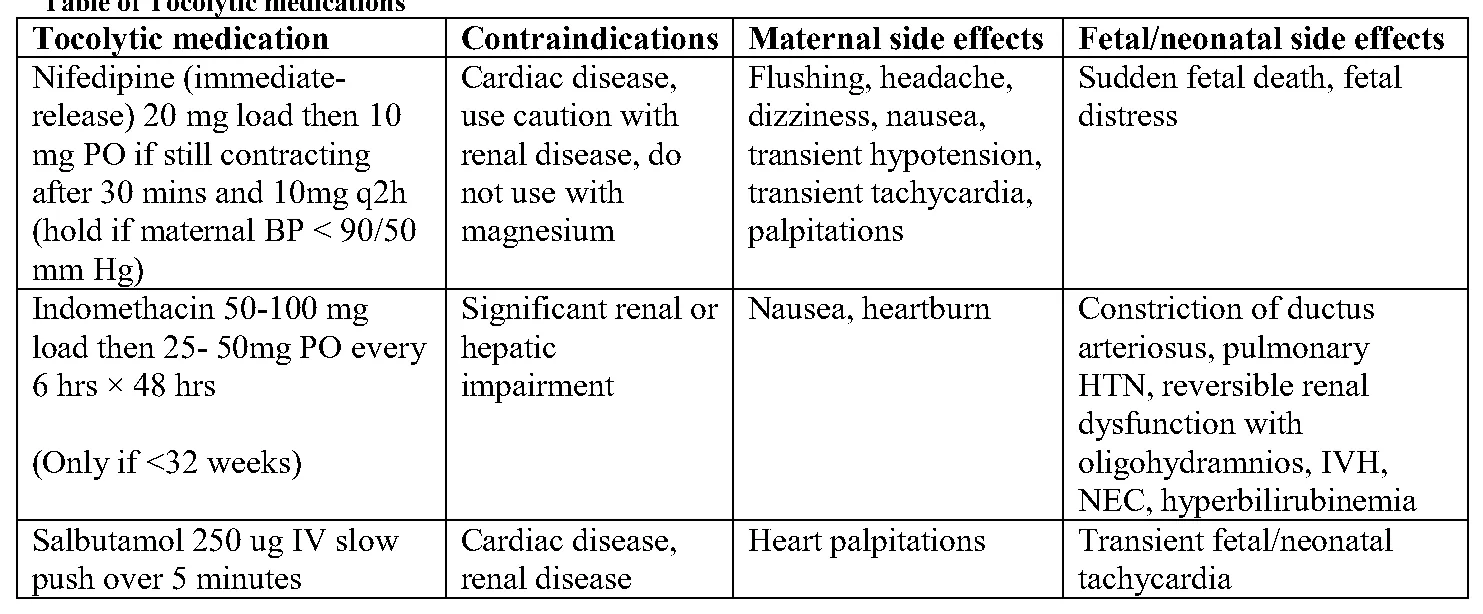
- Tocolytic medications to delay delivery for 48 hrs (for steroids) if contractions are present: see table below
Table of Tocolytic medications Tocolytic medication Contraindications Maternal side effects Fetal/neonatal side effects Nifedipine (immediate- Cardiac disease, Flushing, headache, Sudden fetal death, fetal release) 20 mg load then 10 use caution with dizziness, nausea, distress mg PO if still contracting renal disease, do transient hypotension, after 30 mins and 10mg q2h not use with transient tachycardia, (hold if maternal BP < 90/50 magnesium palpitations mm Hg) Indomethacin 50-100 mg Significant renal or Nausea, heartburn Constriction of ductus load then 25- 50mg PO every hepatic arteriosus, pulmonary 6 hrs × 48 hrs impairment HTN, reversible renal dysfunction with (Only if <32 weeks) oligohydramnios, IVH, NEC, hyperbilirubinemia Salbutamol 250 ug IV slow Cardiac disease, Heart palpitations Transient fetal/neonatal push over 5 minutes renal disease tachycardia
- Delivery and neonatal care
- Inform NICU so that neonatologist or paediatrician may attend delivery
- Deliver with intact membranes if possible
- Minimize trauma by easing out the head in second stage of labour
- Forceps may be used to assist delivery; avoid vacuum extraction
- Suction neonatal airway immediately, avoid hypothermia and transferneonate to NICU as soon as possible
- Consider Caesarean delivery if breech presentation
- Consider using Magnesium sulfate for neuroprotection if viable, EGA <32 weeks, and concern for imminent
preterm birth (dosage as per preeclampsia protocol; or if IV infusion available, give 4g IV loading dose over 30 minutes, followed by 1 g/hr maintenance)1.
- If antenatal magnesium sulfate has been started for fetal neuroprotection, tocolysis should be discontinued.
- For planned preterm birth for fetal of maternal indications, magnesium sulfate should be started ideally
within 4 hours before birth.
- Magnesium sulfate should be discontinued at delivery, if delivery is no longer imminent, or when a
maximum of 24 hours of therapy has been administered.
1Society of Obstetricians and Gynaecologists of Canada. Clinical Practice Guideline #258. Magnesium Sulfate for Fetal Neuroprotection. May 2011.
Tables and figures
Check doses against the printed guideline and your clinical judgement before treating a patient. Spotted an error? Report it from the contact links below.
Need this without data?
The app holds every guideline on your device, with calculators, bookmarks and notes.