
2.6
Antenatal Fetal Surveillance
Obstetrics & Gynaecology Protocols, Version 3.0, 2017. Chapter 2, Labour Ward.
Clinical description
Fetal surveillance aims to evaluate fetal well-being. During antenatal care, the fetal heart is assessed using a fetoscope (≥ 20 wks gestation) or Doppler (≥ 12 wks gestation). For abnormalities or complicated pregnancies, use cardiotocogram (CTG), non stress test (NST), or biophysical profile (BPP).
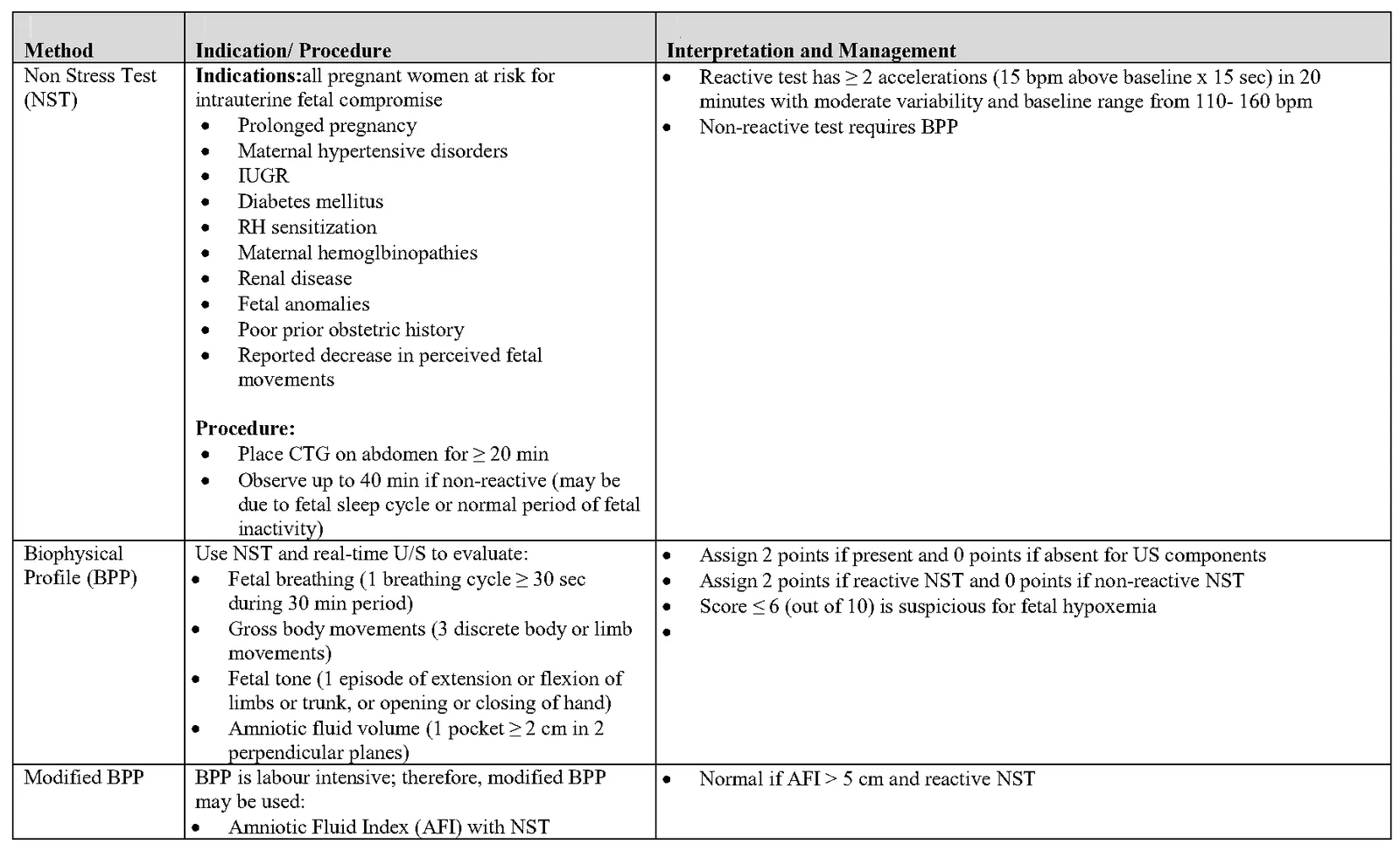
Method Indication/ Procedure Interpretation and Management Non Stress Test Indications:all pregnant women at risk for • Reactive test has ≥ 2 accelerations (15 bpm above baseline x 15 sec) in 20 (NST) intrauterine fetal compromise minutes with moderate variability and baseline range from 110- 160 bpm
- Prolonged pregnancy • Non-reactive test requires BPP
- Maternal hypertensive disorders
- Diabetes mellitus
- RH sensitization
- Maternal hemoglbinopathies
- Renal disease
- Fetal anomalies
- Poor prior obstetric history
- Reported decrease in perceived fetal
movements Procedure:
- Place CTG on abdomen for ≥ 20 min
- Observe up to 40 min if non-reactive (may be
due to fetal sleep cycle or normal period of fetal inactivity) Biophysical Use NST and real-time U/S to evaluate: • Assign 2 points if present and 0 points if absent for US components Profile (BPP) • Fetal breathing (1 breathing cycle ≥ 30 sec • Assign 2 points if reactive NST and 0 points if non-reactive NST during 30 min period) • Score ≤ 6 (out of 10) is suspicious for fetal hypoxemia
- Gross body movements (3 discrete body or limb •
movements)
- Fetal tone (1 episode of extension or flexion of
limbs or trunk, or opening or closing of hand)
- Amniotic fluid volume (1 pocket ≥ 2 cm in 2
perpendicular planes) Modified BPP BPP is labour intensive; therefore, modified BPP • Normal if AFI > 5 cm and reactive NST may be used:
- Amniotic Fluid Index (AFI) with NST
Clinical description
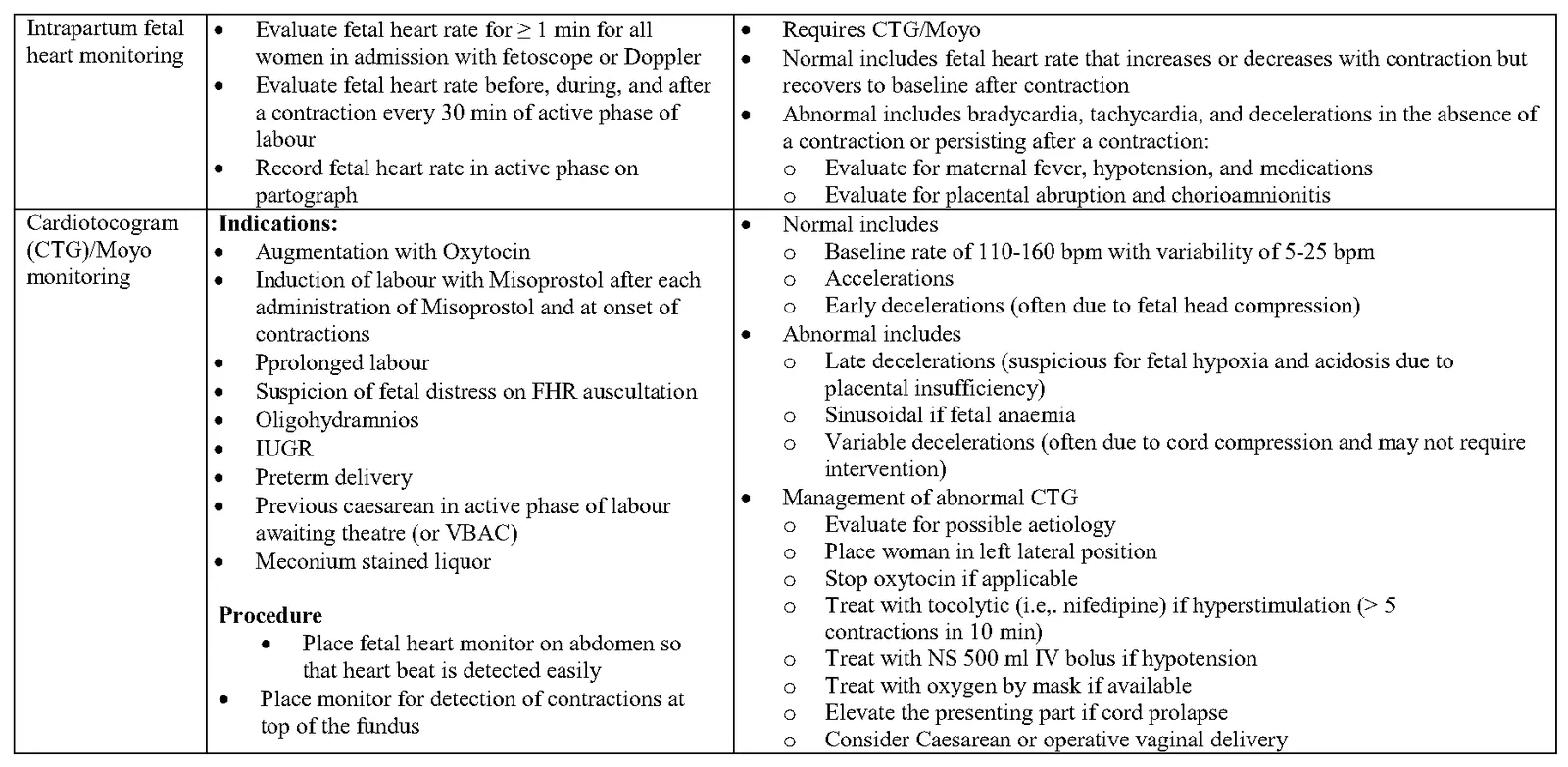
Intrapartum fetal • Evaluate fetal heart rate for ≥ 1 min for all • Requires CTG/Moyo heart monitoring women in admission with fetoscope or Doppler • Normal includes fetal heart rate that increases or decreases with contraction but
- Evaluate fetal heart rate before, during, and after recovers to baseline after contraction
a contraction every 30 min of active phase of • Abnormal includes bradycardia, tachycardia, and decelerations in the absence of labour a contraction or persisting after a contraction:
- Record fetal heart rate in active phase on o Evaluate for maternal fever, hypotension, and medications
partograph o Evaluate for placental abruption and chorioamnionitis Cardiotocogram Indications: • Normal includes (CTG)/Moyo • Augmentation with Oxytocin o Baseline rate of 110-160 bpm with variability of 5-25 bpm monitoring • Induction of labour with Misoprostol after each o Accelerations administration of Misoprostol and at onset of o Early decelerations (often due to fetal head compression) contractions • Abnormal includes
- Pprolonged labour o Late decelerations (suspicious for fetal hypoxia and acidosis due to
- Suspicion of fetal distress on FHR auscultation placental insufficiency)
- Oligohydramnios o Sinusoidal if fetal anaemia
- IUGR o Variable decelerations (often due to cord compression and may not require
intervention)
- Preterm delivery
- Management of abnormal CTG
- Previous caesarean in active phase of labour
- Evaluate for possible aetiology
awaiting theatre (or VBAC)
- Place woman in left lateral position
- Meconium stained liquor
- Stop oxytocin if applicable
- Treat with tocolytic (i.e,. nifedipine) if hyperstimulation (> 5
Procedure contractions in 10 min)
- Place fetal heart monitor on abdomen so
- Treat with NS 500 ml IV bolus if hypotension
that heart beat is detected easily
- Treat with oxygen by mask if available
- Place monitor for detection of contractions at
- Elevate the presenting part if cord prolapse
top of the fundus
- Consider Caesarean or operative vaginal delivery
Fetal surveillance in the absence of CTG/Moyo monitoring:
For all pregnancies:
- Determine gestational age and SFH at every visit; if discrepancy ultrasound scan for fetal growth, AFI if possible
- Refer if abnormal fetal growth or abnormal liquor
- Auscultate FHR at every antenatal visit
- Ask patient about perceived fetal movements
For high risk pregnancies:
- Refer to tertiary hospital
If Gestational age is 40 weeks and above, please see protocol for Post-Term Pregnancy.
Tables and figures
Check doses against the printed guideline and your clinical judgement before treating a patient. Spotted an error? Report it from the contact links below.
Need this without data?
The app holds every guideline on your device, with calculators, bookmarks and notes.