
2.7
Hypertensive Disorders In Pregnancy
Obstetrics & Gynaecology Protocols, Version 3.0, 2017. Chapter 2, Labour Ward.
Clinical description
Hypertensive disorders in pregnancy are associated with increased perinatal morbidity and mortality (i.e. IUFD, IUGR, preterm delivery (PTD)). Take BP with an appropriately sized cuff size (falsely ↑BP if small cuff) when the woman is at rest. Perform an early US for dating because management sometimes depends on GA.
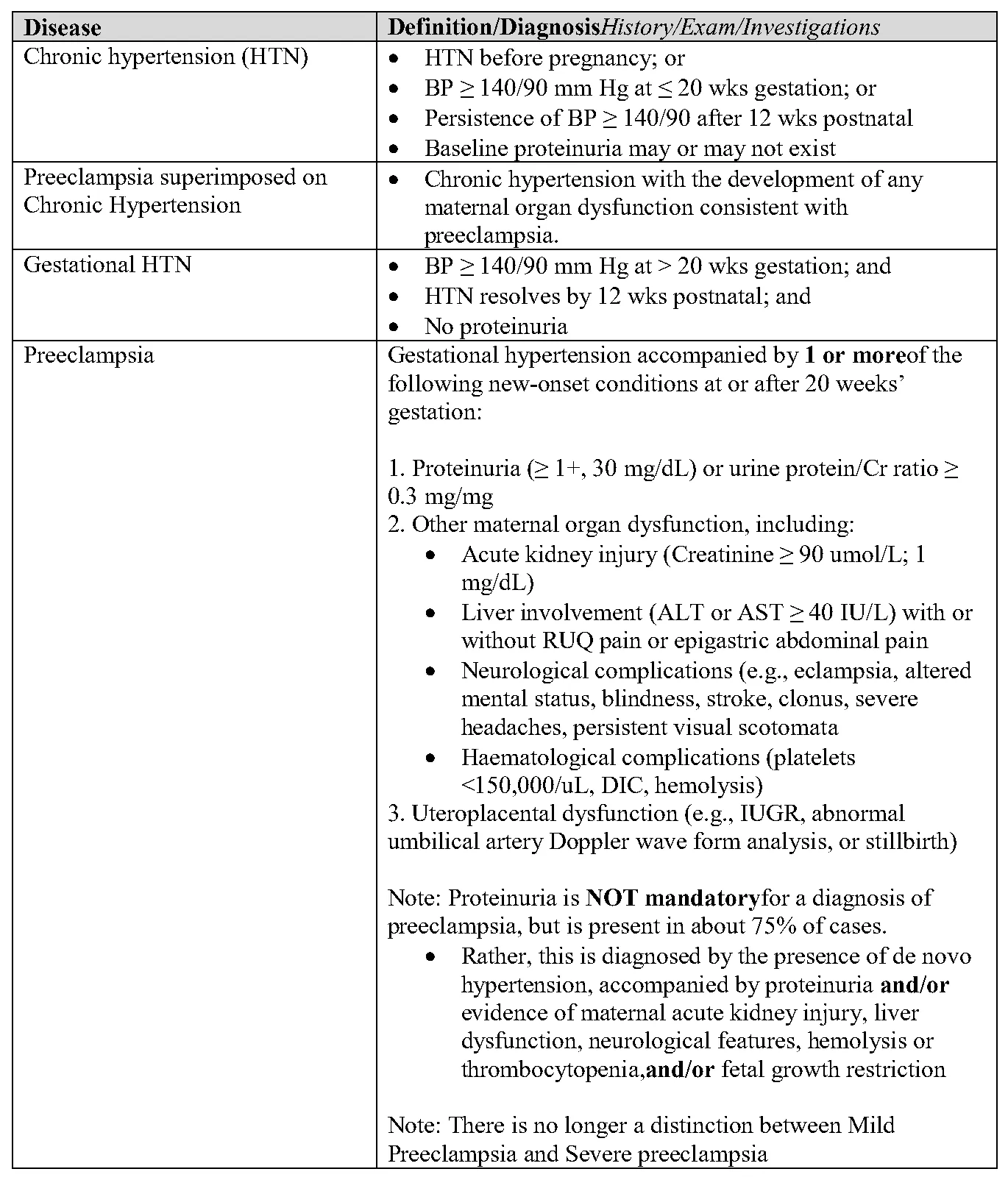
Disease Definition/DiagnosisHistory/Exam/Investigations Chronic hypertension (HTN) • HTN before pregnancy; or
- BP ≥ 140/90 mm Hg at ≤ 20 wks gestation; or
- Persistence of BP ≥ 140/90 after 12 wks postnatal
- Baseline proteinuria may or may not exist
Preeclampsia superimposed on • Chronic hypertension with the development of any Chronic Hypertension maternal organ dysfunction consistent with preeclampsia.
Gestational HTN • BP ≥ 140/90 mm Hg at > 20 wks gestation; and
- HTN resolves by 12 wks postnatal; and
- No proteinuria
Preeclampsia Gestational hypertension accompanied by 1 or moreof the following new-onset conditions at or after 20 weeks’ gestation:
- Proteinuria (≥ 1+, 30 mg/dL) or urine protein/Cr ratio ≥
0.3 mg/mg
- Other maternal organ dysfunction, including:
- Acute kidney injury (Creatinine ≥ 90 umol/L; 1
mg/dL)
- Liver involvement (ALT or AST ≥ 40 IU/L) with or
without RUQ pain or epigastric abdominal pain
- Neurological complications (e.g., eclampsia, altered
mental status, blindness, stroke, clonus, severe headaches, persistent visual scotomata
- Haematological complications (platelets
<150,000/uL, DIC, hemolysis)
- Uteroplacental dysfunction (e.g., IUGR, abnormal
umbilical artery Doppler wave form analysis, or stillbirth) Note: Proteinuria is NOT mandatoryfor a diagnosis of preeclampsia, but is present in about 75% of cases.
- Rather, this is diagnosed by the presence of de novo
hypertension, accompanied by proteinuria and/or evidence of maternal acute kidney injury, liver dysfunction, neurological features, hemolysis or thrombocytopenia,and/or fetal growth restriction Note: There is no longer a distinction between Mild Preeclampsia and Severe preeclampsia
Clinical description
Eclampsia Tonic-clonic seizures that cannot be attributed to any other causes and no past history of seizure disorder I. Management of Chronic Hypertension in Pregnancy
- Stop contraindicated antihypertensive medications (i.e., diuretics, ACE inhibitors (monitor for fetal anomalies)
- Order US to confirm gestational age
- Baseline labs: FBC, LFTs, Cr and BUN
- Urine dipstick for protein; Protein/Creatinine ratio or 24 hr urine protein collection if proteinuria is present
- Consider fundoscopic exam and ECG
- Use antihypertensives to maintain blood pressure in the range 110-140/80- 85 mmHg
- Acceptable initial anti-hypertensives include methyldopa and nifedipine.
- Hydralazine should be used as a second line agent.
- Monitor for developing pre-eclampsia using urine dipstick at each visit along with clinical assessment, and
blood tests (Hb, platelet count, liver transaminases, uric acid and creatinine) at 28 and 34 weeks as a minimum.
- Assess fetal well-being with ultrasound from 26 weeks gestation and thereafter at 2-4 weekly intervals if fetal
biometry is normal and more frequently in the presence of suspected fetal growth restriction. Measure AFI with each ultrasound exam
- FOR WOMEN WITH SUPERIMPOSED PRE-ECLAMPSIA: Superimposed pre-eclampsia is an
indication for delivery. Administer corticosteroids and MgSo4 as indicated.
- FOR WOMEN WITH CHRONIC HYPERTENSION AND NO ADDITIONAL MATERNAL OR FETAL
COMPLICATIONS, deliver at 39 weeks (ISSHP) gestation II. Management of Gestational Hypertension
- Control blood pressure with methyldopa or nifedipine to levels of 110-140/85 mmHg, as above
- Monitor for the development of pre-eclampsia
- Monitor fetal growth
- Delivery can be delayed until 39+6 weeks provided blood pressure can be controlled, fetal monitoring is
reassuring and pre-eclampsia has not developed.
III. Management of Pre-eclampsia
- All women with pre-eclampsia should be hospitalized and placed in Labor Ward or HDU for evaluation.
a. If early onset (<34 weeks), refer to Central Hospital for management.
- Blood pressure requires urgent treatment in a monitored setting when ≥ 160/110 mmHg; acceptable agents for
this include oral nifedipine or intravenous hydralazine
- Blood pressures should be consistently maintained below 160 systolic and below 85 mmHg diastolic.
- Women with pre-eclampsia who have severe hypertension, or hypertension with neurological signs or
symptoms should receive MgSO4 for convulsion prophylaxis.
- Where available, fetal monitoring in pre-eclampsia should include assessment of fetal biometry, amniotic fluid
and umbilical artery Doppler with ultrasound at first diagnosis and thereafter at 2 weekly intervals if the initial assessment was normal and more frequently in the presence of fetal growth restriction.
a. If there is absent end-diastolic flow in the umbilical artery (AEDF) prior to 34 weeks’ gestation, the patient should be delivered.
- Maternal monitoring in pre-eclampsia should include: BP monitoring, repeated assessments for proteinuria if
not already present, clinical assessment including reflexes & clonus, FBC, LFTs and Creatinine at least twice weekly
- There should be no attempt to diagnose ‘mild’ vs. ‘severe’ pre-eclampsia clinically as all cases may become
severe, often rapidly.
- Women with pre-eclampsia should be deliveredif they have reached 34 weeks gestation, or sooner if they
develop any of the following severe features:
a. Repeated episodes of severe hypertension despite maintenance treatment;
b. Progressive thrombocytopenia;
c. Progressively abnormal renal or liver enzyme tests;
d. Pulmonary oedema;
e. Abnormal neurological features such as severe intractable headache,
Clinical description
f. Repeated visual scotomata, or convulsions; or g. Non-reassuring fetal status.
- Prenatal corticosteroids for fetal lung maturation should be given between 24+0 and 34+0 weeks gestation, but
may be given up until 37+0 weeks in cases of elective delivery by Caesarean section; multiple steroid courses are not recommended.
a. Note:The use of corticosteroids beyond 34 weeks gestation has not been validated in low resource settings.
- Postpartum hypertension and pre-eclampsia can lead to eclampsia.
a. Patients should be counseled on prodromal warning signs at the time of discharge.
IV. Management of Eclampsia Initial management
- Check circulation, airway, breathing (CAB). Correct hypoxia with oxygen as needed.
- Protect patient from injury (left lateral position in bed with rails or on floor)
- Admit to LW or HDU
- Place IV and control BP: hydralazine 5 mg IV every 15 minutes, with titration up to 10 mg as needed to a
total dose of 40 mg in an hour, until BP < 160/110 mmHg.
- If BP still not controlled after reaching max dose of hydralazine, refer to Central Hospital.
- For those units with infusion pump and intensive monitoring, if BP >160/110 mm Hg, consider 20
mg hydralazine in 200 ml infusion to run at 20, 40, 60 ml/hr until targeted BP of < 160/110.
- If fully conscious, give Methyldopa 500 mg 8 hourly or Nifedipine (short-acting/immediate release) 10-20
mg q8 hourly concurrently with hydralazine regimen if BP > 160/110 mm Hg.
- Prevent more seizures: MgSO4 4 g (20 ml of 20% solution) IV in 500 mL NS over 10 min AND 5 g (10 ml
of 50% solution) IM in each buttock with 1 ml of 2% lignocaine loading dose in same syringe. If no IV, then IM only.
- If convulsions recur after 15 minutes, then give another MgSO 2 g (10 ml of 20% solution) IV over 5 min.
4
- If seizures continue or MgSO not available, consider Diazepam 10 mg IM or IV over 2 min.
4
- Maintenance dose of Diazepam is 40 mg in 500 mL of NS or LR.
- Assess for mode of delivery (assisted vaginal delivery or caesarean delivery)
Labour & delivery, postnatal management
- Maintain airway, stop seizures, inform senior obstetrician and anaesthetist and exclude other causes
- Monitor BP, PR, RR, urine output (UOP), deep tendon reflexes and level of consciousness
- If UOP < 30 ml/hr, then withhold MgSO4
- If absent knee jerk reflex or RR < 16/min, then magnesium toxicity; give Calcium Gluconate
1 g 10% IV over 10 min and stop magnesium
- Give IV fluids cautiously: NS ≤ 1.5-2 L over 24 hrs or ≤ 80 mL/hr
- MgSO4 5 g (with 1 ml of 2% lignocaine) IM every 4 hours in alternate buttock for 24 hrs after last
seizure or delivery, whichever is later
- If seizures still recur, then
Call for help, senior obstetrician, senior anaesthetist and experienced midwives Repeat MgSO4 load; give Diazepam or Thiopental x 1 if persistent Intubate to maintain airway and ventilate
- Once seizures are controlled, start delivery process
- Decision to delivery must be made to deliver the pregnant woman within 12 hours. Consider
caesarean if unlikely to deliver in 6-12 hours regardless of gestational age.
- For vaginal delivery, assist with second stage (i.e. vacuum or forceps)
- Give Oxytocin 10 IU by IV push in 3rd stage
- Do NOT use ergometrine in hypertensive women
- Control BP (goal BP < 160/110):
- Hydralazine IV and/or Nifedipine PO
Clinical description
Starting dose of Nifedipine SR 10 mg TDS; max 40 mg TDS
- After delivery:
- Continue MgSO4 until 24 hours after delivery or the last seizure
- For blood pressure management, refer to section on Hypertensive Disorders.
V. The Use of IM Magnesium Sulfate for Pre-Eclampsia
- In low resource settings, all women with pre-eclampsia should receive magnesium sulphate
injections for convulsion prophylaxis.
- CHECK PLATELET COUNT OR BEDSIDE CLOTTING TEST PRIOR TO IM INJECTIONS
TO AVOID THE DEVELOPMENT OF SUBCUTANEOUS HEMATOMAS AT THE INJECTION SITE.
- IF AVAILABLE, CONSIDER THE USE OF AN IV INFUSION PUMP.
- Loading dose: 4 gm is administered as an intravenous dose Then 5 gm in one buttock and
another 5 gm in the other buttock. These together constitute the loading dose (14 gm).
- Maintenance dose: Thereafter, 5 gm is administered in alternate buttocks every 4 hours for 24 hr
Signs of MgSO4 toxicity
- Respiratory rate <10/min
- SaO2 < 92%
- Muscle Paralysis
- Reflexes absent
IF TOXICITY SUSPECTED, CEASE THE INFUSION IMMEDIATELY AND ADMINISTER CALCIUM VI. Prevention of Pre-Eclampsia in High Risk Patients
- Use low dose aspirin (100-150 mg/d) preferably started before 16 weeks of pregnancy for women at increased
risk for pre-eclampsia, particularly if any of the following conditions exist:
- Previous pre-eclampsia,
- Pre-existing medical conditions (including chronic hypertension,
- Underlying renal disease, or pre-gestational diabetes mellitus),
- Antiphospholipid antibody syndrome,
- Multiple pregnancy;
- Obesity
- Assisted reproduction pregnancy
- In the face of low calcium intake (<600mg/day), use calcium 1.2 to 2.5g per day in women at increased risk.
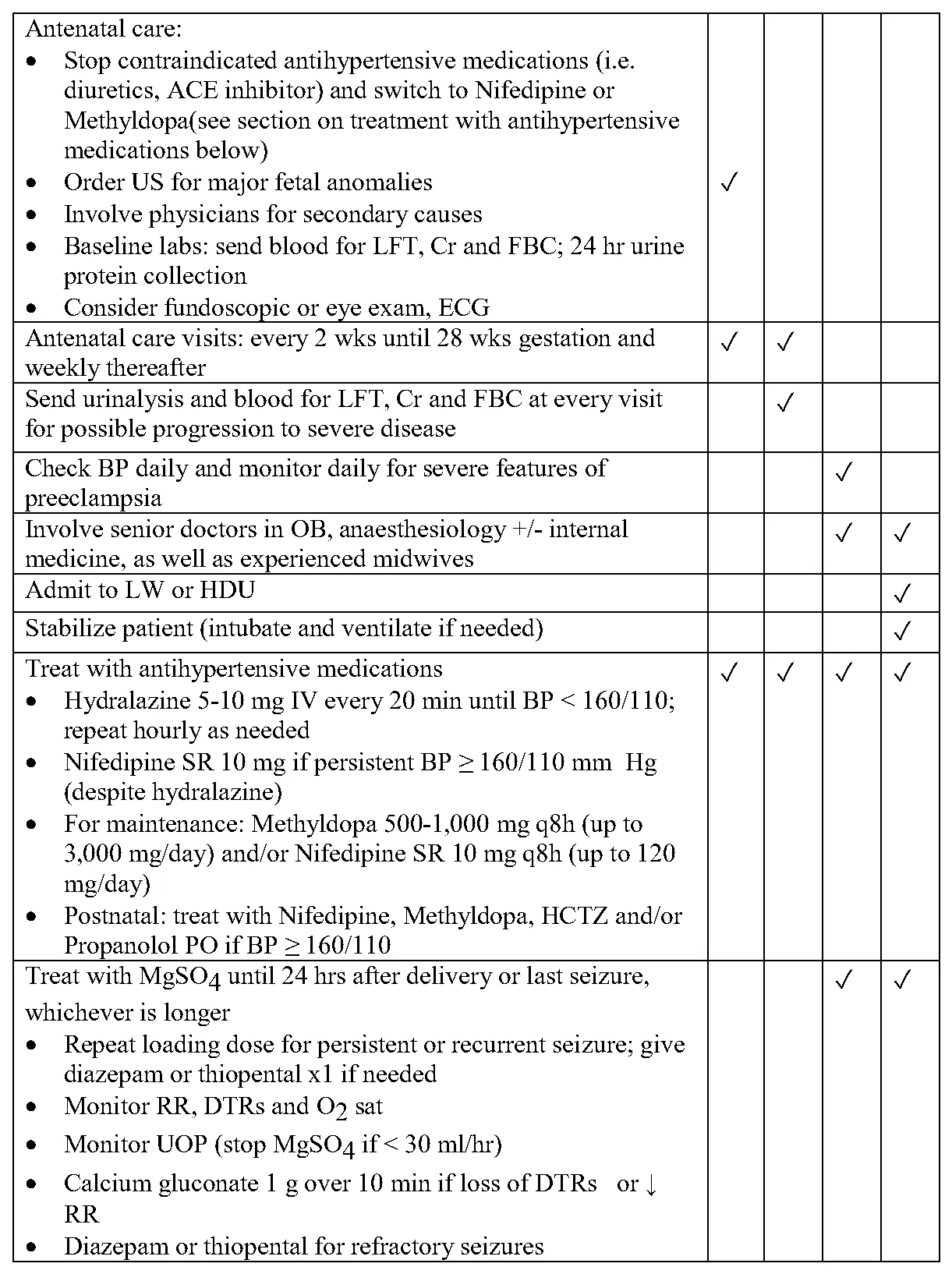
Table for Management of Hypertensive Disorders in Pregnancy
Treatment
NTH cinorhC NTH lanoitatseG aispmalceerP aispmalcE
Clinical description
Antenatal care:
- Stop contraindicated antihypertensive medications (i.e.
diuretics, ACE inhibitor) and switch to Nifedipine or Methyldopa(see section on treatment with antihypertensive medications below)
- Order US for major fetal anomalies ✓
- Involve physicians for secondary causes
- Baseline labs: send blood for LFT, Cr and FBC; 24 hr urine
protein collection
- Consider fundoscopic or eye exam, ECG
Antenatal care visits: every 2 wks until 28 wks gestation and ✓ ✓ weekly thereafter Send urinalysis and blood for LFT, Cr and FBC at every visit ✓ for possible progression to severe disease Check BP daily and monitor daily for severe features of ✓ preeclampsia Involve senior doctors in OB, anaesthesiology +/- internal ✓ ✓ medicine, as well as experienced midwives Admit to LW or HDU ✓ Stabilize patient (intubate and ventilate if needed) ✓ Treat with antihypertensive medications ✓ ✓ ✓ ✓
- Hydralazine 5-10 mg IV every 20 min until BP < 160/110;
repeat hourly as needed
- Nifedipine SR 10 mg if persistent BP ≥ 160/110 mm Hg
(despite hydralazine)
- For maintenance: Methyldopa 500-1,000 mg q8h (up to
3,000 mg/day) and/or Nifedipine SR 10 mg q8h (up to 120 mg/day)
- Postnatal: treat with Nifedipine, Methyldopa, HCTZ and/or
Propanolol PO if BP ≥ 160/110 Treat with MgSO4 until 24 hrs after delivery or last seizure, ✓ ✓ whichever is longer
- Repeat loading dose for persistent or recurrent seizure; give
diazepam or thiopental x1 if needed
- Monitor RR, DTRs and O2 sat
- Monitor UOP (stop MgSO4 if < 30 ml/hr)
- Calcium gluconate 1 g over 10 min if loss of DTRs or ↓
RR
- Diazepam or thiopental for refractory seizures
Tables and figures

Check doses against the printed guideline and your clinical judgement before treating a patient. Spotted an error? Report it from the contact links below.
Need this without data?
The app holds every guideline on your device, with calculators, bookmarks and notes.