
2.10
Malpresentation, Abnormal Position And Transverse Lie
Obstetrics & Gynaecology Protocols, Version 3.0, 2017. Chapter 2, Labour Ward.
Clinical description
Malpresentation refers to any abnormalities of the fetal presenting part, normal being cephalic presentation. Abnormal fetal position includes non-occiput anterior positioning of the fetal head during labour. With transverse lie, there is no presenting part.
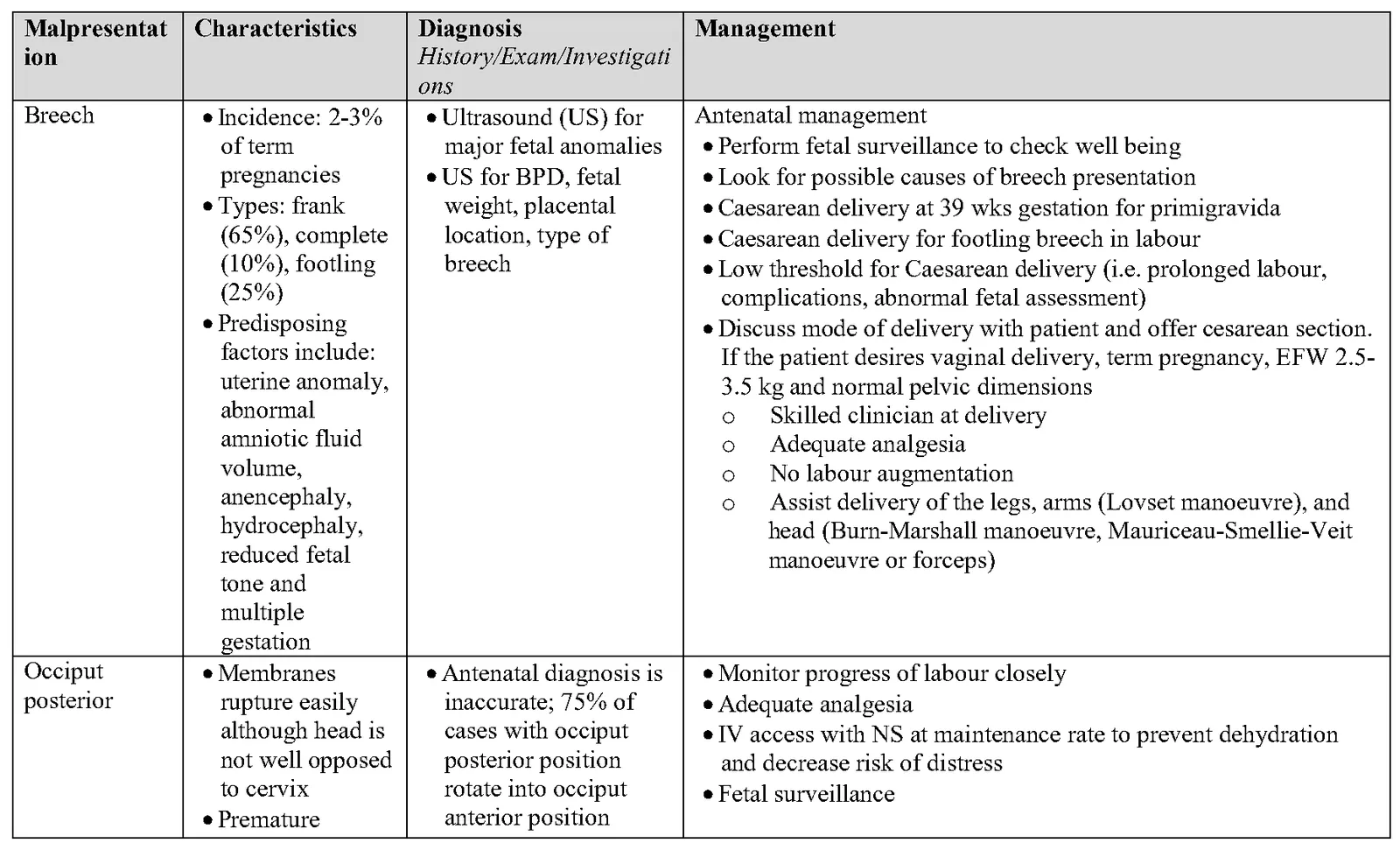
Malpresentat Characteristics Diagnosis Management ion History/Exam/Investigati ons Breech • Incidence: 2-3% • Ultrasound (US) for Antenatal management of term major fetal anomalies • Perform fetal surveillance to check well being pregnancies • US for BPD, fetal • Look for possible causes of breech presentation
- Types: frank weight, placental • Caesarean delivery at 39 wks gestation for primigravida
(65%), complete location, type of • Caesarean delivery for footling breech in labour (10%), footling breech • Low threshold for Caesarean delivery (i.e. prolonged labour, (25%) complications, abnormal fetal assessment)
- Predisposing • Discuss mode of delivery with patient and offer cesarean section.
factors include: If the patient desires vaginal delivery, term pregnancy, EFW 2.5- uterine anomaly, 3.5 kg and normal pelvic dimensions abnormal o Skilled clinician at delivery amniotic fluid o Adequate analgesia volume, o No labour augmentation anencephaly, o Assist delivery of the legs, arms (Lovset manoeuvre), and hydrocephaly, head (Burn-Marshall manoeuvre, Mauriceau-Smellie-Veit reduced fetal manoeuvre or forceps) tone and multiple gestation Occiput • Membranes • Antenatal diagnosis is • Monitor progress of labour closely posterior rupture easily inaccurate; 75% of • Adequate analgesia although head is cases with occiput • IV access with NS at maintenance rate to prevent dehydration not well opposed posterior position and decrease risk of distress to cervix rotate into occiput • Fetal surveillance
- Premature anterior position
Clinical description
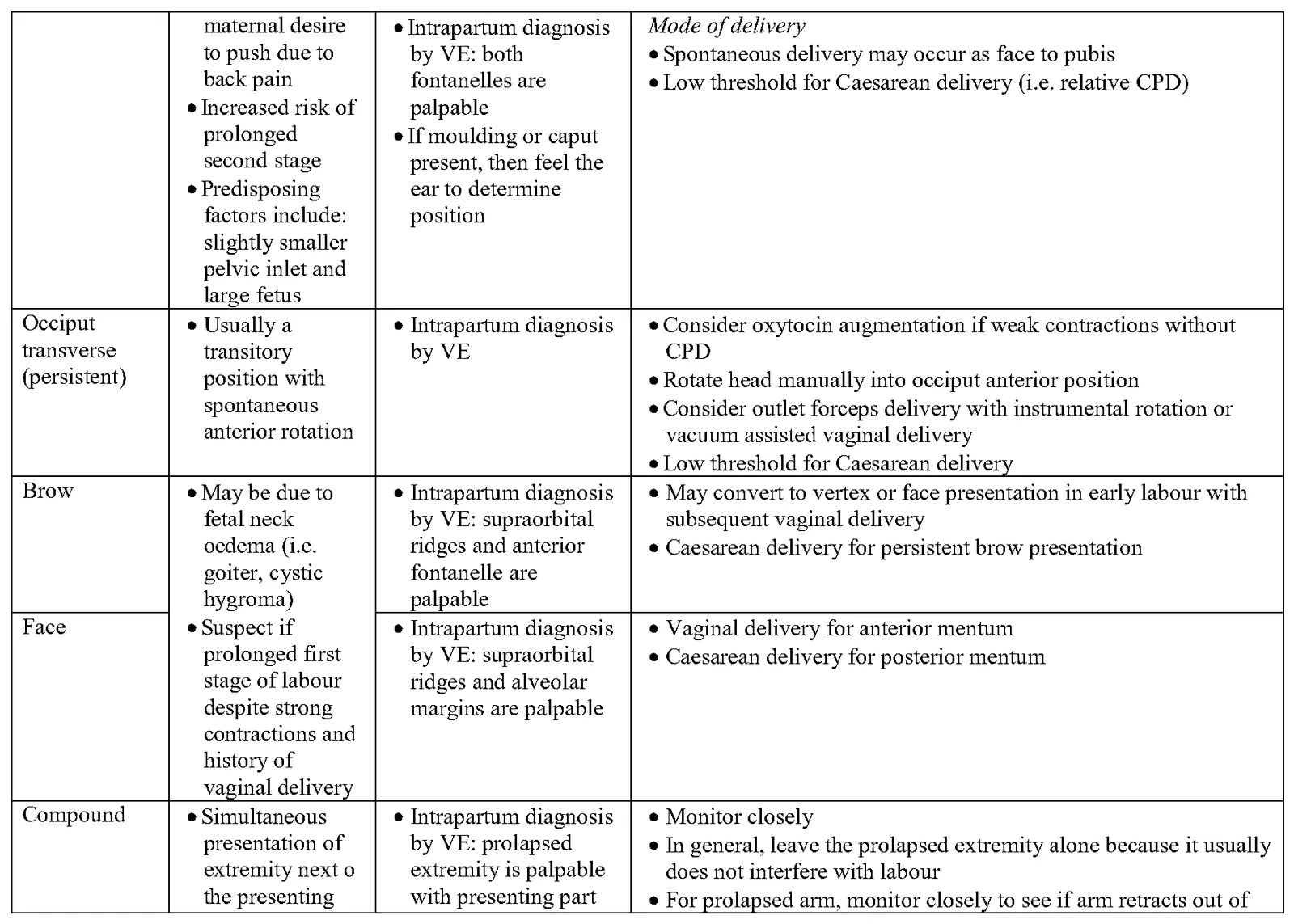
maternal desire • Intrapartum diagnosis Mode of delivery to push due to by VE: both • Spontaneous delivery may occur as face to pubis back pain fontanelles are • Low threshold for Caesarean delivery (i.e. relative CPD)
- Increased risk of palpable
prolonged • If moulding or caput second stage present, then feel the
- Predisposing ear to determine
factors include: position slightly smaller pelvic inlet and large fetus Occiput • Usually a • Intrapartum diagnosis • Consider oxytocin augmentation if weak contractions without transverse transitory by VE CPD (persistent) position with • Rotate head manually into occiput anterior position spontaneous • Consider outlet forceps delivery with instrumental rotation or anterior rotation vacuum assisted vaginal delivery
- Low threshold for Caesarean delivery
Brow • May be due to • Intrapartum diagnosis • May convert to vertex or face presentation in early labour with fetal neck by VE: supraorbital subsequent vaginal delivery oedema (i.e. ridges and anterior • Caesarean delivery for persistent brow presentation goiter, cystic fontanelle are hygroma) palpable Face • Suspect if • Intrapartum diagnosis • Vaginal delivery for anterior mentum prolonged first by VE: supraorbital • Caesarean delivery for posterior mentum stage of labour ridges and alveolar despite strong margins are palpable contractions and history of vaginal delivery Compound • Simultaneous • Intrapartum diagnosis • Monitor closely presentation of by VE: prolapsed • In general, leave the prolapsed extremity alone because it usually extremity next o extremity is palpable does not interfere with labour the presenting with presenting part • For prolapsed arm, monitor closely to see if arm retracts out of
Clinical description
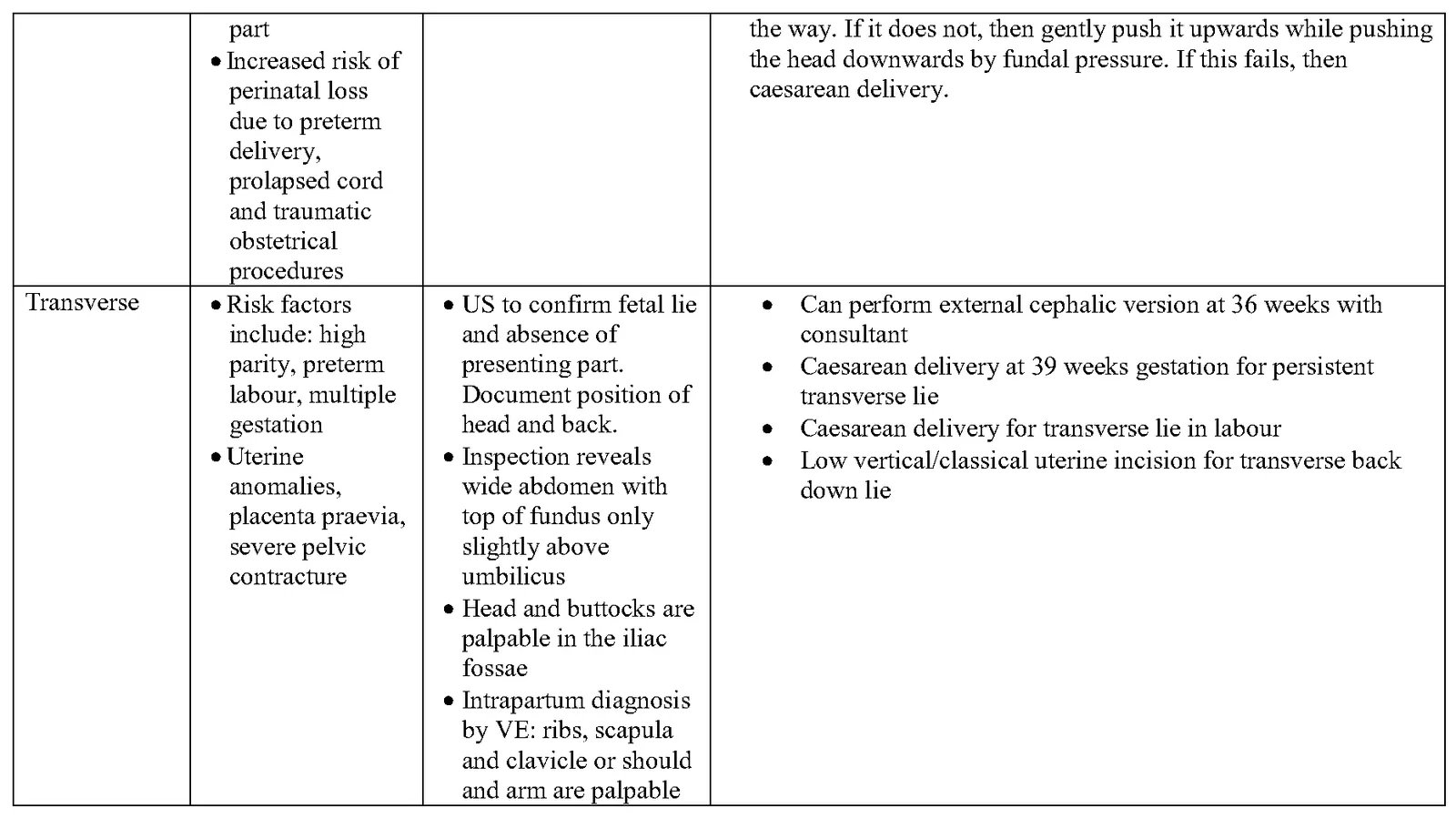
part the way. If it does not, then gently push it upwards while pushing
- Increased risk of the head downwards by fundal pressure. If this fails, then
perinatal loss caesarean delivery.
due to preterm delivery, prolapsed cord and traumatic obstetrical procedures Transverse • Risk factors • US to confirm fetal lie • Can perform external cephalic version at 36 weeks with include: high and absence of consultant parity, preterm presenting part. • Caesarean delivery at 39 weeks gestation for persistent labour, multiple Document position of transverse lie gestation head and back. • Caesarean delivery for transverse lie in labour
- Uterine • Inspection reveals • Low vertical/classical uterine incision for transverse back
anomalies, wide abdomen with down lie placenta praevia, top of fundus only severe pelvic slightly above contracture umbilicus
- Head and buttocks are
palpable in the iliac fossae
- Intrapartum diagnosis
by VE: ribs, scapula and clavicle or should and arm are palpable
Tables and figures
Check doses against the printed guideline and your clinical judgement before treating a patient. Spotted an error? Report it from the contact links below.
Need this without data?
The app holds every guideline on your device, with calculators, bookmarks and notes.