
2.13
Operative Vaginal Delivery: Forceps And Vacuum
Obstetrics & Gynaecology Protocols, Version 3.0, 2017. Chapter 2, Labour Ward.
Clinical description
Operative vaginal delivery (or assisted vaginal delivery) may be performed via forceps or vacuum.
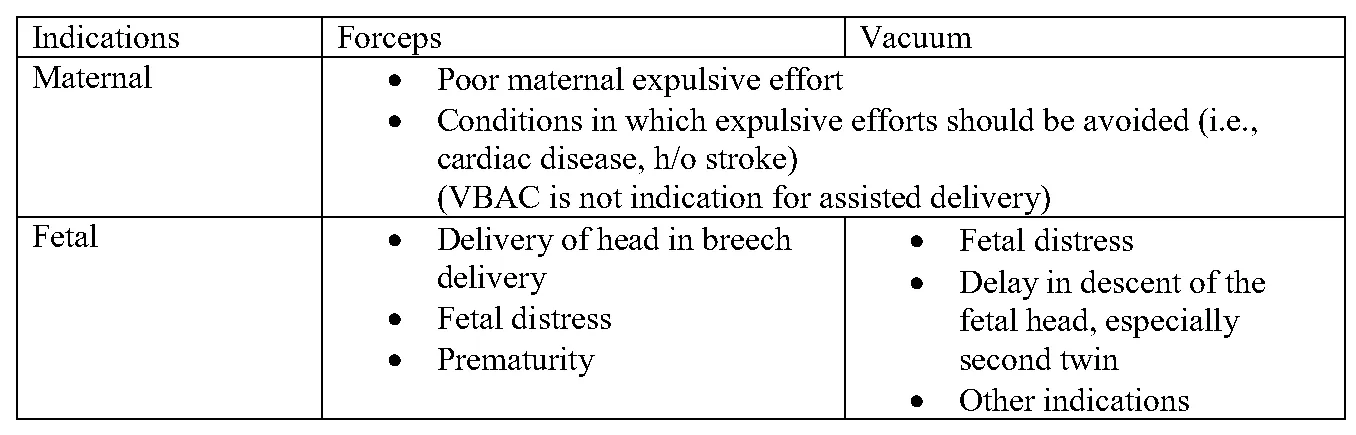
Indications Forceps Vacuum Maternal • Poor maternal expulsive effort
- Conditions in which expulsive efforts should be avoided (i.e.,
cardiac disease, h/o stroke) (VBAC is not indication for assisted delivery) Fetal • Delivery of head in breech • Fetal distress delivery • Delay in descent of the
- Fetal distress fetal head, especially
- Prematurity second twin
- Other indications
Signs and symptoms
History/Exam/Investigations Document indication(s) for operative vaginal delivery clearly in the file
Treatment
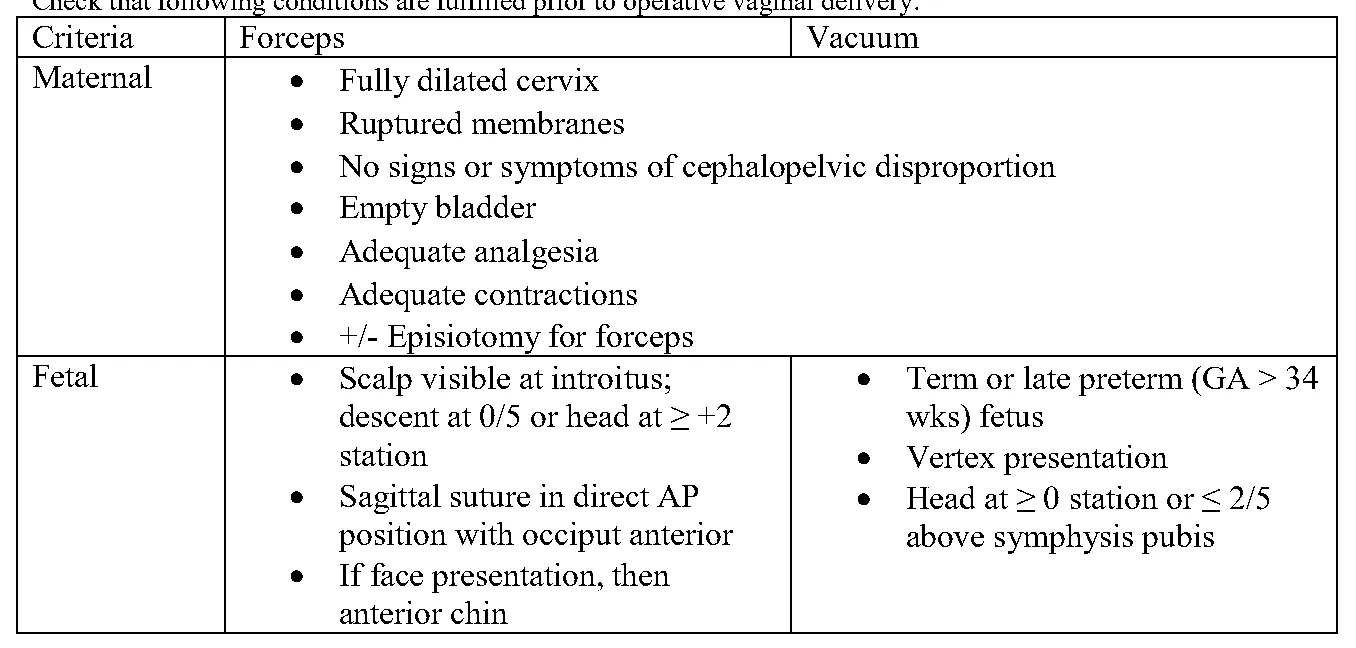
Check that following conditions are fulfilled prior to operative vaginal delivery:
Criteria Forceps Vacuum Maternal • Fully dilated cervix
- Ruptured membranes
- No signs or symptoms of cephalopelvic disproportion
- Empty bladder
- Adequate analgesia
- Adequate contractions
- +/- Episiotomy for forceps
Fetal • Scalp visible at introitus; • Term or late preterm (GA > 34 descent at 0/5 or head at ≥ +2 wks) fetus station • Vertex presentation
- Sagittal suture in direct AP • Head at ≥ 0 station or ≤ 2/5
position with occiput anterior above symphysis pubis
- If face presentation, then
anterior chin Procedure
- Make sure theater space is available when attempting an operative vaginal delivery
- Use aseptic technique
- Performed by obstetrician or experienced/trained midwife
- Explain procedure and provide emotional support and encouragement to mother (who should continue to
push if not contraindicated)
- For forceps application
- Test the locking mechanism
- Lubricate the blades with sterile lubricant
- Insert left blade first +/- episiotomy
- If difficulty with locking, then recheck position of fetal head and re- apply blades as indicated
Clinical description
- For vacuum application
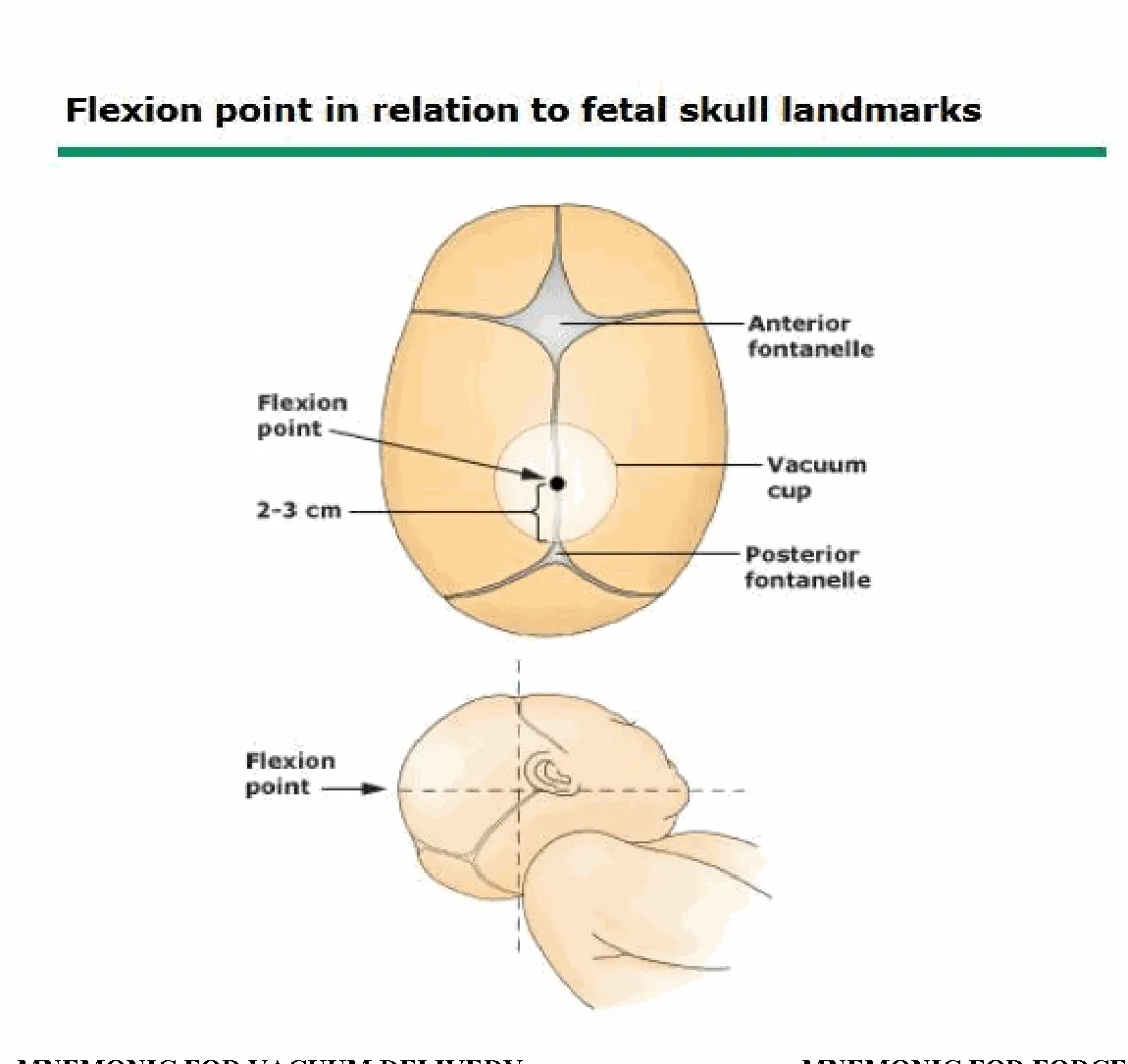
- Identify the posterior fontanelle
- Place cup ~2-3 cm anterior to posterior fontanelle
- Check that there is no maternal tissue trapped within cup
- Create vacuum seal slowly from 0.2 kg/cm2 to 0.8 kg/cm2
- Pull in direction of birth canal axis (initially, downward and forward) with each contraction; expect descent
with each combination of pulling and maternal pushing
- Proceed to Caesarean delivery if there is no descent after 2 pulls or after 30 min or 2 pop-offs occur.
Clinical description
MNEMONIC FOR VACUUM DELIVERY MNEMONIC FOR FORCEPS DELIVERY A Address the patient A Address the patient Ask for help Ask for help Anesthesia adequate? Anesthesia adequate? B Bladder empty B Bladder empty C Cervix must be completely dilated C Cervix must be completely dilated D Determine position of head D Determine position of head Think of Dystocia Think of Dystocia E Equipment ready E Equipment ready F Place cap in proper position to posterior Fontanelle F Forceps ready Feel for maternal tissue before and after suction Posterior fontanelle midway between shanks, G Gentle traction following the pelvic curve 1 cm above plane of shanks H Halt traction between contractions Fenestrations admit no more than 1 fingertip Halt procedures if pop-off 3 times G Gentle traction Halt procedure if no progress in 3 pulls H Handle elevated to follow the pelvic curve Halt procedure after 20 minutes of use I Incision: evaluate for episiotomy when crowning I Incision: evaluate for episiotomy when crowning (episiotomy not usuallyrecommended) (episiotomy not usually recommended) J Remove cup when Jaw is reachable J Remove forceps when Jaw is reachable
Tables and figures
Check doses against the printed guideline and your clinical judgement before treating a patient. Spotted an error? Report it from the contact links below.
Need this without data?
The app holds every guideline on your device, with calculators, bookmarks and notes.