
4.9
Gynaecologic Infections And Pelvic Inflammatory Disease
Obstetrics & Gynaecology Protocols, Version 3.0, 2017. Chapter 4, Gynaecology.
Clinical description
The following guidelines are taken from the Malawi Guidelines for Syndromic Management of Sexually Transmitted Infections, Malawi Ministry of Health, 2017.
*Note: all patients who present with STI symptoms should be offered HIV Testing and Counseling and VIA.
- Abnormal Vaginal Discharge
Causes: vaginal infection, cervical infection, endometrial infection/pelvic inflammatory disease (PID)
- Common causes of vaginal infections: trichomonas vaginalis, Candida albicans and bacterial vaginosis.
- Common Causes of cervical infections: Neisseria gonorrheae and Chlamydia trachomatis.
Note: Vaginal discharge is normal during and after sexual activity, at various points throughout the menstrual period, and during pregnancy and lactation.
General Management
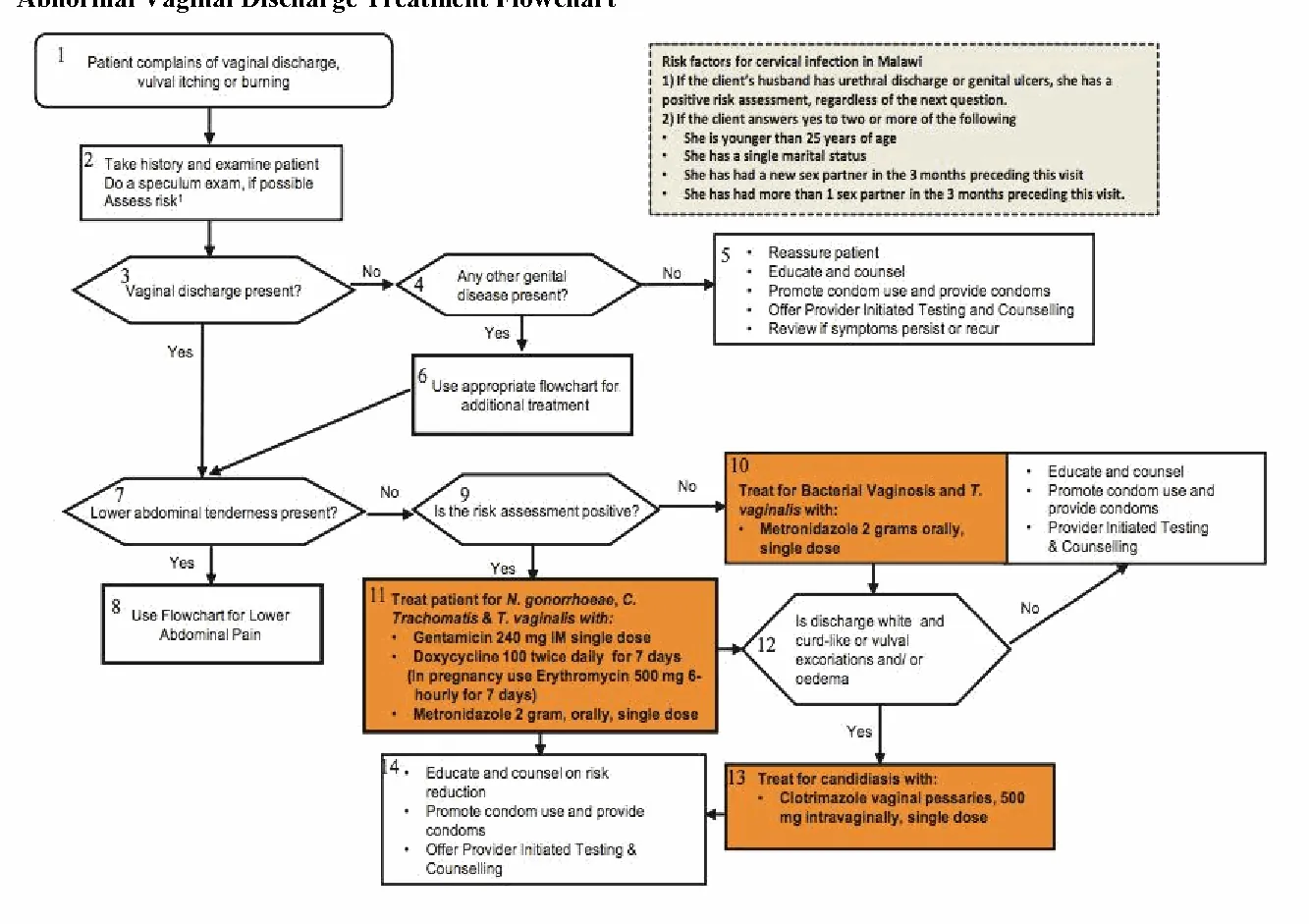
- Must perform speculum exam on all women who complain of abnormal vaginal discharge to
evaluate for cervical cancer.
- Do risk assessment to identify women at risk of cervical infection
- Treat for vaginitis to those with negative risk assessment
- Treat for cervicitis and vaginal infection to those with positive risk assessment.
- Treat all women with vaginal discharge and a positive risk assessment for gonococcus and Chlamydia
infection, plus trichomoniasis and bacterial vaginosis:
- If the discharge is white and curd-like also treat for candidiasis.
- Treat all women with vaginal discharge and a negative risk assessment for trichomoniasis and
bacterial vaginosis:
- If the discharge is white and curd-like, also treat for candidiasis.
Treatment
- If vaginal discharge is present and the risk assessment is positive:
- Gentamicin 240mg IM stat plus
- Doxycycline 100mg orally every 12 hours for 7 days (in pregnancy use Erythromycin 500mg 6-
hourly for 7 days), plus
- Metronidazole 2g orally single dose
- If vaginal discharge is present and risk assessment is negative:
- Metronidazole 2g orally single dose stat
- If the discharge is white or curd-like add 1 Clotrimazole Pessary 500mg PV x 1 OR Miconazole 200
mg PV x 3 days OR Fluconazole 150 mg PO x 1 (not in pregnancy)
- If no discharge is found and risk assessment is positive:
- Gentamicin 240mg IM stat plus
- Doxycycline 100mg orally every 12 hours for 7 days
- If no discharge is found and risk assessment is negative:
- Reassure client, counsel, educate and provide condoms.
- Advise client to come back if symptoms persist.
- Offer HIV testing after providing information and counseling
Clinical description
Abnormal Vaginal Discharge Treatment Flowchart
- Genital Ulcer Disease
Common Causes: genital herpes, chancroid and syphilis may be present concurrently.
- Genital herpes is the most prevalent amongst the three.
- Treat patients with GUD for the above three infections
General Management
- Aspirate fluctuant lymph nodes (buboes) through adjacent normal (i.e., uninflamed) skin.
- Do not incise.
- Ask patients to return if non-fluctuant nodes become fluctuant
- Treat sexual partner(s)
Treatment
- Ciprofloxacin 500mg orally stat twice daily for 3 days, and
- Benzathine penicillin 2.4 MU i/m stat
- Acyclovir 800mg 3 times per day for 2 days (unless primary infection, then 400mg orally 3 times per
day for 10 days)
- Tell patient to return for follow-up care in 7-10 days, see below
- Note: Acyclovir is indicated only in symptomatic GUD clients
If patient allergic to penicillin:
- Erythromycin 500mg every 6 hours for 15 days plus
- Acyclovir 800mg orally every 12 hours for 7 days
If patient allergic to penicillin/Ciprofloxacin and pregnant or lactating:
- Erythromycin 500mg every 6 hours for 15 days and acyclovir 800mg
- every 12 hours for 7 days
- Infants born to mothers treated for GUD with Erythromycin alone:
Clinical description
- Benzathine Penicillin 500,000 IU/kg as a single dose
Follow-up care of GUD
- Inform the patient to return 7-10 days after starting treatment.
- If the ulcers have not healed or are getting worse, repeat GUD treatment if there is evidence of
noncompliance.
- If the client complied fully and there is no improvement, consider treatment for granuloma inguinale
and lymphogranuloma venereum:
- Give Doxycycline 100mg orally twice per day for 14 days
- Review in further 7-10 days
- If no improvement, refer for specialist opinion
- If improved, follow patient’s progress until completely healed
- No further antibiotics are required at this time
- If the ulcers have improved but not completely healed:
- Repeat chancroid treatment Ciprofloxacin 500mg single dose
- Review in further 7-10 days
- If ulcers have completed healed:
- Reinforce counseling and patient education
- Promote/provide condoms
- Genital Warts (Low-Risk Human Papilloma Infection)
Common causes: HPV 6 and 11.
- Should be distinguished from condyloma of secondary syphilis and molluscum contagiosum.
- Besides local caustic applications, surgical removal or electrocautery may be used for treatment:
- For more extensive growth
- When topical applications have failed
- When topical applications are contraindicated
- Increase in size and number in pregnancy.
- Cutting warts with scissors or razors in the outpatient setting is contraindicated and can result in
excessive bleeding.
Treatment
- Apply Compound Podophyllin Paint to the lesions at weekly intervals (contraindicated in pregnancy
and lactation)
- Apply Yellow Soft Paraffin or Vaseline to avoid normal tissue
- Use only for scattered growth
- When applied to vulval mucosa or to meatal warts, allow to dry before coming back into contact with
normal epithelium
- Remove the paint by washing off after 1-4 hours
- If no effect after 4-6 weeks, stop treatment and consider alternative methods of removal
Alternatively to Podophyllin Paint, and for treating vulvar warts:
- Apply Silver Nitrate Stick (pencil) once daily (acceptable alternative during pregnancy and lactation)
If pregnant:
- Podophyllin, 5 fluorouracil, and interferons are contraindicated in pregnancy.
- Lesions often improve or regress following delivery, so eradication of wards during pregnancy may
not be necessary.
- Vaginal delivery can be allowed unless genital warts are obstructing the outlet or will lead to excessive
bleeding.
- There is a low risk of juvenile onset recurrent respiratory papillomatosis in neonates exposed to warts,
but risk of transmission is not associated with mode of delivery and therefore, cesarean delivery is not recommended solely to prevent HPV transmission.
- Herpes Simplex Virus
Clinical description
Causes: Type 1 (affects lips), Type 2 (affects genitals but can interchange dueto oral sex)
Treatment
- Acyclovir Cream or GV Paint or Silver Sulphadiazine Cream Application twice a day
- Aspirin 300mg or Paracetamol
- In severe conditions give Acyclovir200-400 mg every 8 hours for 5 to 7 days and consider checking
HIV
- Pelvic Inflammatory Disease
Definition: Infection of the female genital tract above the internal cervical os, including: endometritis, salpingitis, tubo-ovarian abscess and pelvic peritonitis.
Causes: most commonly from Gonorrheal or Chlamydialor anaerobic bacterialinfection but may also be caused by other intra-abdominal/pelvic bacteria.
Diagnosis: any 1 of the following 3 symptoms: cervical motion tenderness, uterine tenderness, adnexal tenderness. May also have abnormal discharge, fever, of elevated WBC.
Treatment
- Gentamicin 240mg IM x 1
- Doxycycline 100 mg q12 hours x 14 days
- Metronidazole 400 mg q8 hours x 14 days
- Treat partner with Gentamicin and Doxycycline
- If not improved within 72 hours, not tolerating oral intake, signs of sepsis, or pelvic mass, admit for
inpatient treatment:
- Gentamicin 1.5 mg/kg IV or IM q8 hours
- Clindamycin 900 mg IV q 8 hours
- Metronidazole 500 mg IV q8 hours
When improved and able to swallow:
- Add Doxycycline 100 mg PO q12 hours x 10 days
- Switch from IV to PO Metronidazole 400 mg q18 hours x 10 days
- Syphilis
Signs and symptoms
- Early syphilis: primary (ulcer), secondary (generalized skin rashes,condylomata lata) or latent syphilis of
not more than 2 years duration
- Late syphilis: benign, cardiovascular and latent syphilis of more than 2years; syphilis of indeterminate
duration
- Congenital syphilis in children
- Treat as late syphilis all patients with a positive RPR or VDRL and nodocumented syphilis serology in the
last 2 years.
Treatment for early syphilis:
- Benzathine Penicillin one dose of 2.4 MU IM
- Divide as 1.2 MU into each buttock
- Alternatively, if hypersensitivity to penicillin:
- Doxycycline 100mg every 12 hours for 15 days
- Note: In pregnancy/lactation, substitute with Erythromycin 500mg q6 hours for 15 days
Treatment for late syphilis:
- Benzathine Penicillin 1 dose of 2.4 MU i/m at weekly intervals for 3 weeks (total of 3 doses)
- Divide each weekly dose 1.2 MU into each buttock: total (3 doses) is7.2 MU
- Alternatively, if hypersensitivity to penicillin:
- Doxycycline 100mg orally every 12 hours for 30 days
- Note: In pregnancy/lactation, substitute with Erythromycin 500mg q6 hours for 30 days
Tables and figures
Check doses against the printed guideline and your clinical judgement before treating a patient. Spotted an error? Report it from the contact links below.
Need this without data?
The app holds every guideline on your device, with calculators, bookmarks and notes.