
4.8
Contraception
Obstetrics & Gynaecology Protocols, Version 3.0, 2017. Chapter 4, Gynaecology.
Clinical description
Contraception helps couples to avoid unwanted pregnancy and short interpregnancy intervals (<2 years between births).
Pertinent History for Contraceptive Counseling
- Obstetric history: any past pregnancies/deliveries
- Gynaecological history: Characteristics of her menses (regularity, how heavy, how long), last menstrual period,
any history of STIs or abnormal vaginal discharge, past contraceptive use (if any), current condom use
- Medical history: HIV, hypertension, stroke, VTE, breast cancer, liver disease, etc.
- Medication history: any ART or TB medication, allergies
- Social/sexual history: how many lifetime sexual partners, how many current partners, future fertility intentions
Counseling about available methods Counsel about most effective methods first. Also counsel about dual method use (using condoms with another contraceptive) since condoms are the only contraceptive that also protect against HIV and STIs.
- Sterilization:
- Typical use 1st year failure rate for vasectomy: 0.15%
- Typical use 1st year failure rate for bilateral tubal ligation: 0.5%
Irreversible; counsel about increased risk of ectopic if she does become pregnant
- Intrauterine contraceptive device (IUCD, also known as IUD)
- Typical use 1st year failure rate for ParaGard (copper T): 0.8%
Lasts 10-12 years
- Typical use 1st year failure rate for levonorgestrel IUCD: 0.2%
Lasts 5-7 years
- Both can be inserted in HIV-infected women or women with h/o gonorrhea or chlamydia if treated
more than 3 months ago
- Both can be inserted in adolescents and nulliparous women
- Implant
- Implanon/Nexplanon® contains the progestin etonorgestrel and lasts up to 3 years.
Typical use 1st year failure rate: 0.05%
- Jadelle® contains the progestin levonorgestrel and lasts up to 5 years.
Typical use 1st year failure rate: 0.05%
- Both implants may have reduced contraceptive effectiveness when among women taking Rifampicin
or Efavirenz-based ART; such women should be counseled to use condoms along with the implant.
- Injectable, also known as Depo Provera® or depot medroxyprogesterone acetate (DMPA)
- Typical use 1st year failure rate: 6% - Needs to be given every 13 weeks (2-week grace period before and after)
- Oral contraceptives (OC):
- Typical use 1st year failure rate: 9%
- Must be taken every day
- Combined oral contraceptives (COC): containboth ethinyl estradiol and a progestin, e.g., Microgynon
Clinical description
- Avoid in women with hypertension; smokers ≥ 35 years;history of or multiple risk factors for
stroke, cardiovascular disease or VTE; lupus, migraines with aura, diabetes with evidence of microvascular disease; breast or liver cancer, severe cirrhosis, acute hepatitis
- Progestin-only pills (POP): contain only a progestin, e.g., Microlut (levonorgestrel)
- Must be taken within 3 hours of when next dose is due, or decreased effectiveness
- Both types of pills may have reduced contraceptive effectiveness when among women taking
Rifampicin or Efavirenz-based ART; such women should be counseled to use condoms along with the pills.
- Condoms:
- Male condom typical use 1st year failure rate: 18%
- Female condom typical use 1st year failure rate: 21%
- Withdrawal:
- Typical use 1st year failure rate: 22%
- Fertility awareness-based methods (“natural family planning methods” such as cycle beads)
- Typical use 1st year failure rate: 24%
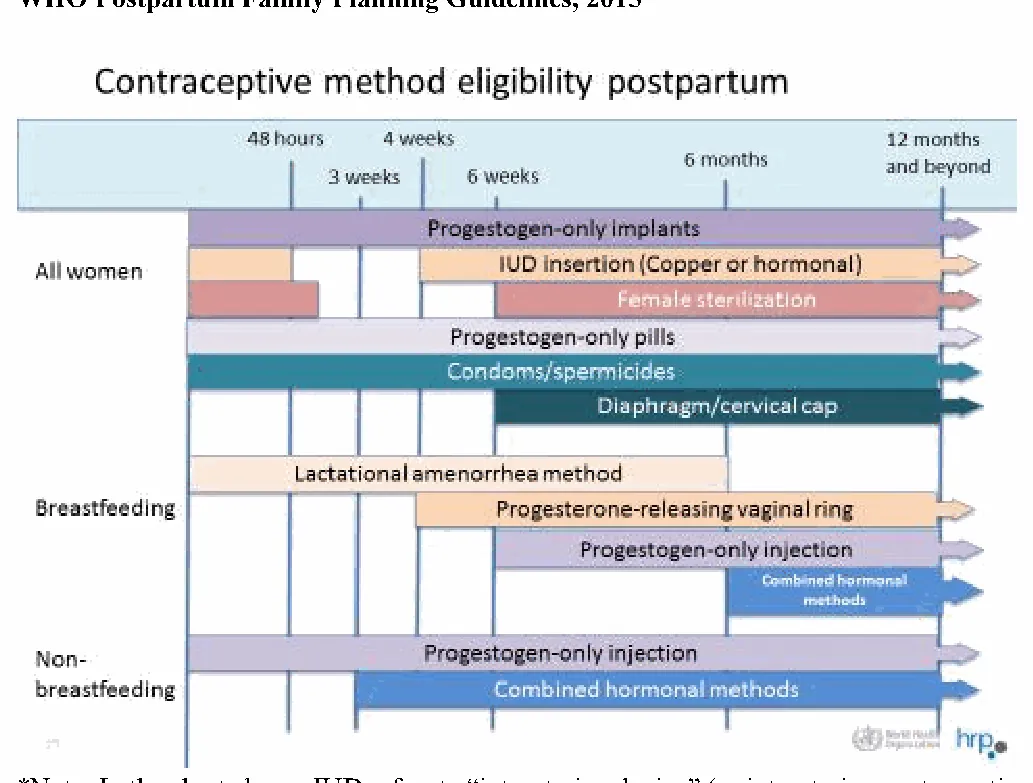
WHO Postpartum Family Planning Guidelines, 2015 *Note: In the chart above, IUD refers to “intrauterine device” (or intrauterine contraceptive device, IUCD), not “intrauterine death”.
**Note: Progestin-only pills and implants can be given immediately postpartum anytime after delivery of the placenta.
Tables and figures
Check doses against the printed guideline and your clinical judgement before treating a patient. Spotted an error? Report it from the contact links below.
Need this without data?
The app holds every guideline on your device, with calculators, bookmarks and notes.