
4.2
Adnexal Masses
Obstetrics & Gynaecology Protocols, Version 3.0, 2017. Chapter 4, Gynaecology.
Clinical description
Adnexal masses are a common reason for gynecologic referral. Although most adnexal masses are benign, the goal of the diagnostic evaluation is to exclude malignancy.
Management decisions often are influenced by the age and family history of the patient; older age and family history of breast or ovarian cancers raise the index of suspicion for malignancy.
Signs and symptoms
History Abdominal pain, nausea/vomiting, abdominal swelling, +/- light PVB, family history Exam Examine lymph nodes, lungs, abdomen and pelvis (visual, bimanual and +/- rectovaginal exam). Concerning findings include firm, irregular, fixed, nodular, and/or bilateral masses. Ascites is also concerning for malignancy).
Investigations
UPT: rule out pregnancy/ectopic pregnancy.
Pelvic US: note size, simple versus solid and/or cystic, cystic wall structure (smooth versus papillary projections), and presence/absence of ascites.
Laboratory: FBC if infection suspected. CA-125 (a serum tumor marker for epithelial ovarian cancer) may be considered in postmenopausal women with high index of suspicion for cancer.
Differential diagnosis:
- Gynecologic
a. Benign i. Functional cyst ii. Leiomyomata iii. Endometrioma iv. Tuboovarian abscess v. Ectopic pregnancy vi. Mature teratoma (dermoid) vii. Serous cystadenoma viii. Mucinous cystadenoma ix. Hydrosalpinx x. Ectopic pregnancy b. Malignant i. Germ cell tumour ii. Sex-cord or stromal tumour iii. Epithelial carcinoma iv. Metastatic cancer
- Nongynecologic
a. Benign i. Diverticular abscess ii. Appendiceal abscess or mucocele iii. Nerve sheath tumours iv. Ureteral diverticulum v. Pelvic kidney vi. Paratubal cysts vii. Bladder diverticulum b. Malignant i. Gastrointestinal cancers ii. Retroperitoneal sarcoma iii. Metastases
Treatment
- If asymptomatic simple cyst up to 10 cm, may be managed with observation and serial pelvic ultrasounds
as needed.
- If asymptomatic cyst noted during the luteal phase, may be a corpus luteal cyst. Repeat pelvic ultrasound in
6 weeks during follicular phase of cycle to assess for resolution of cyst.
- If severe pain with cyst > 2 cm, consider emergency laparotomy for suspected torsion. Torsion may also
present with nausea, vomiting, fever, and elevated WBC.
- If symptomatic cyst > 4 cm, can consider exploratory laparotomy and cystectomy versus oophorectomy
depending on surgical findings.
- If any concern for malignancy, such as a solid or complex mass of any size, refer to Central Hospital.
- If symptomatic with fever, consider tubo-ovarian abscess and treat with inpatient antibiotics. Plan for
exploratory laparotomy if no improvement within 48 hours.
- Send all surgical specimens for histopathology. Consider frozen section if any features concerning for
malignancy noted (papillary excresances, ascites, metastases).
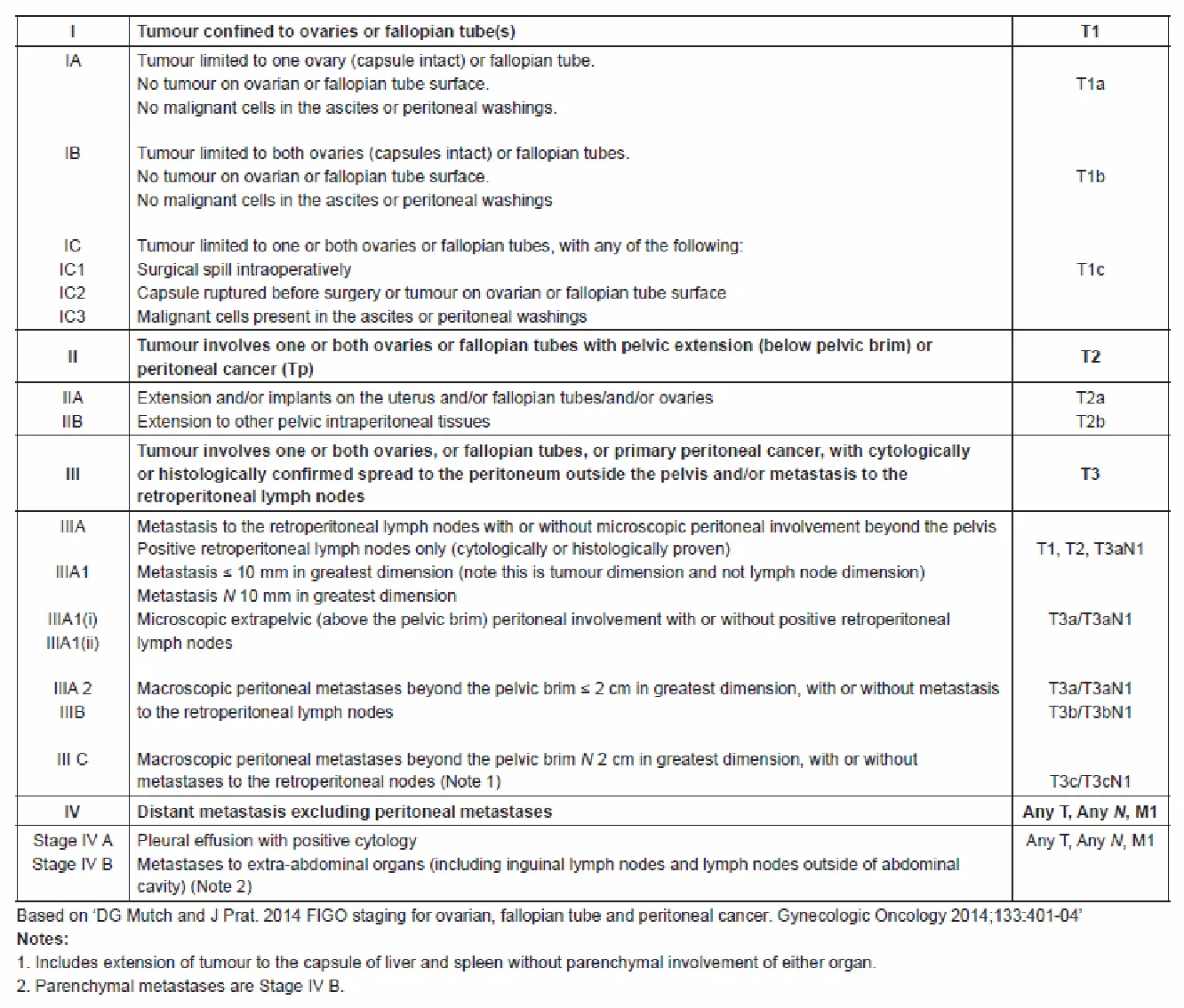
- Perform staging if pathology positive for malignancy.
Tables and figures
Check doses against the printed guideline and your clinical judgement before treating a patient. Spotted an error? Report it from the contact links below.
Need this without data?
The app holds every guideline on your device, with calculators, bookmarks and notes.