
4.1
Abnormal Uterine Bleeding (Aub)
Obstetrics & Gynaecology Protocols, Version 3.0, 2017. Chapter 4, Gynaecology.
Clinical description
Menstrual flow outside of normal volume, duration, regularity, or frequency is considered AUB.
The duration of normal menstrual flow is generally 5 days and the normal menstrual cycle typically lasts between 21 and 35 days.
Menorrhagia: heavy menstrual bleeding, typically defined as menstrual blood loss > 80 mL Metrorrhagia: bleeding between periods Menometrorhagia: heavy menstrual bleeding and bleeding between periods Oligomenorrhea:bleeding that occurs less frequently than every 35 days Polymenorhea: bleeding that occurs more often that every 21 days PALM-COEIN classification system introduced in 2011 by FIGO and classified uterine bleeding abnormalities by bleeding pattern as well as by etiology:
PALM: Structural Causes COEIN: Nonstructural Causes Polyp Coagulopathy (Von Willebrand’s, warfarin use, etc.) Adenomyosis Ovulatory dysfunction (PCOS, thyroid disease, etc.) Leiomyoma Endometrial (endometritis, AVMs.) Malignancy & hyperplasia Iatrogenic (medications) Not yet classified
Signs and symptoms
History/Exam Age of menarche/menopause, menstrual bleeding pattern, severity of bleeding (clots or flooding), pain (severity and treatment), medical conditions, surgical history, use of medications (coumadin, NSAIDs, hormonal contraception, etc.), symptoms of possible hemostatic disorder (easybruising/bleeding).
On exam, check BMI, look for signs for PCOS (hirsutism, acne) and insulin resistance (acanthosis nigricans on neck), and perform bimanual and speculum exams.
InvestigationsUPT, FBC (check Hb and Plt), targeted screening for bleeding disorders (if available), TSH and PRL (if available), and pelvic ultrasound. Endometrial biopsy or dilation and curettage for any women who:
- Is age 45 years or older or has elevated risk for endometrial cancer (i.e. elevated BMI)
- Has postmenopausal bleeding
- Has history of unopposed estrogen exposure (including PCOS).
Treatment
Treatment is dependent on the aetiology of AUB. Iron supplementation for symptomatic anaemia.
- Structural causes (PALM)
Polyp: polypectomy in operating theatre.
Adenomyosis: dysmenorrhea, menorrhagia, bulky uterus on exam or ultrasound
- Hormonal treatment with either oral contraceptive pills, Provera, or Depo-provera injection
- Panadol and Bufren as needed
- If adnexal mass noted on exam or persistent, complex mass noted on ultrasound, refer to Central Hospital,
where they will consider cystectomy/oophorectomy for possible endometrioma
- Consider hysterectomy if done with childbearing if failed medical management
Leiomyoma: menorrhagia; may feel pressure on bladder, rectum or spine; large bulky uterus on exam; fibroids noted on ultrasound
Clinical description
- Hormonal treatment with either oral contraceptive pills, Provera or Depo-provera injection. Consider
GnRH agonist if available.
- Panadol and Bufren as needed
- Consider hysterectomy if done with childbearing
Malignancy & hyperplasia:
WHO divides hyperplasia into 3 classifications, which have different incidence rates for endometrial cancer:
- Simple without atypia (1%)
- Complex without atypia (3%)
- Simple with atypia (8%)
- Complex with atypia (29%)
For hyperplasia with atypia, a hysterectomy +/- BSO should be done if childbearing is complete. If hyperplasia without atypia or if fertility is desired, can start on Depo-Provera injection or Provera 10-20 mg PO daily with endometrial sampling every 3 months until hyperplasia is resolved, and then yearly thereafter.
For malignancy, patient will need to be taken for exploratory laparotomy, TAH/BSO, staging, and possible pelvic and periaortic lymph node dissection.
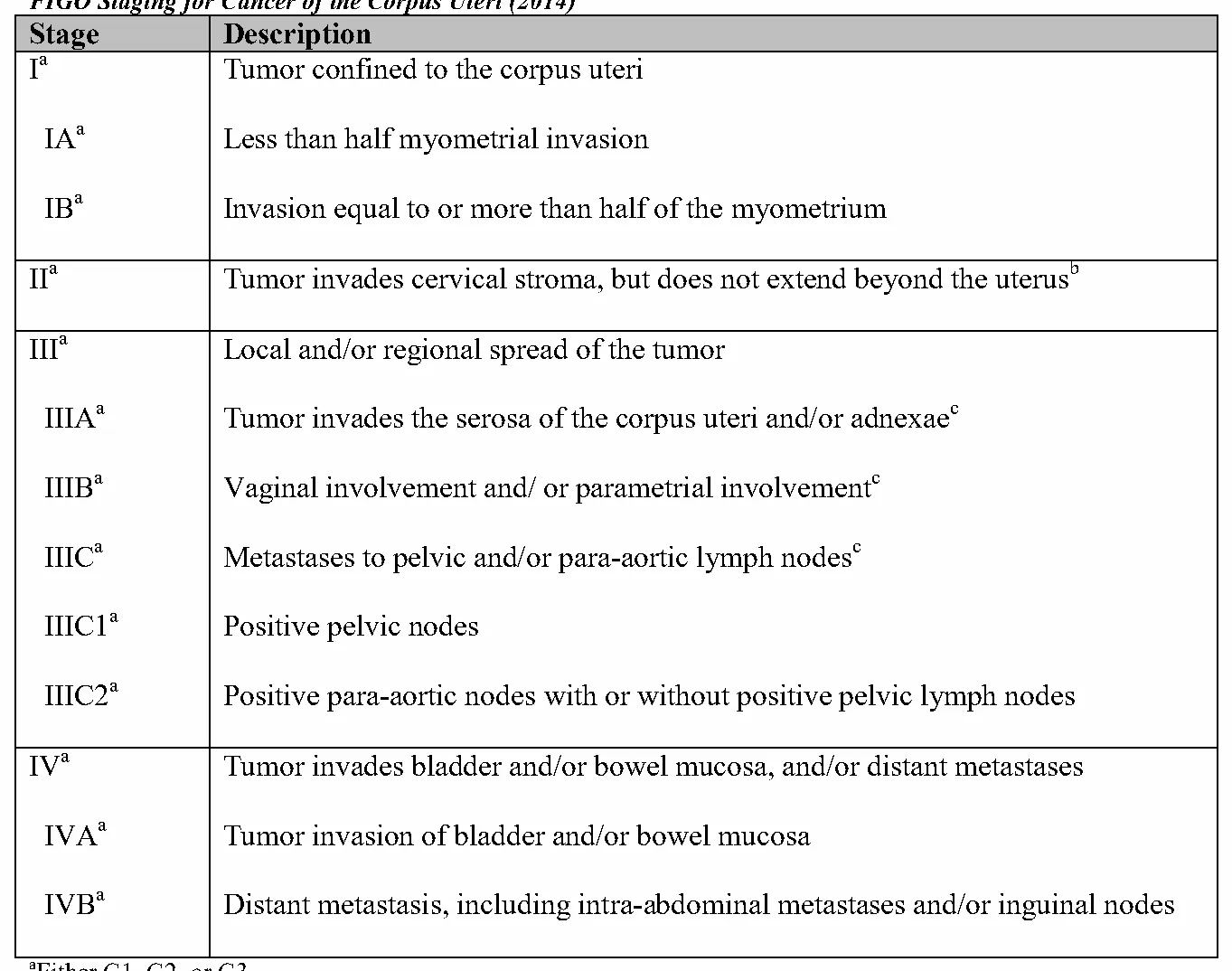
FIGO Staging for Cancer of the Corpus Uteri (2014) Stage Description Ia Tumor confined to the corpus uteri IAa Less than half myometrial invasion IBa Invasion equal to or more than half of the myometrium IIa Tumor invades cervical stroma, but does not extend beyond the uterusb IIIa Local and/or regional spread of the tumor IIIAa Tumor invades the serosa of the corpus uteri and/or adnexaec IIIBa Vaginal involvement and/ or parametrial involvementc IIICa Metastases to pelvic and/or para-aortic lymph nodesc IIIC1a Positive pelvic nodes IIIC2a Positive para-aortic nodes with or without positive pelvic lymph nodes IVa Tumor invades bladder and/or bowel mucosa, and/or distant metastases IVAa Tumor invasion of bladder and/or bowel mucosa IVBa Distant metastasis, including intra-abdominal metastases and/or inguinal nodes aEither G1, G2, or G3.
bEndocervical glandular involvement only should be considered as Stage I and no longer as Stage II.
cPositive cytology has to be reported separately without changing the stage.
Clinical description
- Nonstructural causes (COEIN)
Coagulopathy:Refer to Haematology.
Ovulatory dysfunction:
- Adolescence: combined hormonal contraceptive pills.
- Androgen-ProducingTumours: Ovarian tumours should be removed via salpingo-oophorectomy and sent to
Pathology for histologic evaluation. Adrenal tumours should be referred to Surgery for management.
- Congenital Adrenal Hyperplasia: refer to Pediatrics/Endocrinology.
- CNS Tumours: refer to Surgery/Neurosurgery.
- Hypothalamic Amenorrhea: Usually associated with anorexia, poor nutritional status or excessive stress or
exercise, so lifestyle changes and counseling to correct these causes should be performed.
- Hypothyroidism: start on Levothyroxine 1.6 mcg/kg/day. Recheck TSH in 6 weeks and titrate dose by 12-
25 mcg/day as needed, rechecking TSH every 6 weeks until normal TSH level.
- Perimenopause: can start on oral contraceptive pills (progestin-only pills if history of hypertension or other
risk factors for thromboembolic disease), Depo-Provera injections, or Provera pills as needed.
- Pituitary Insufficiency: Refer to Medicine/Endocrinology.
- Pituitary Lesion (Prolactinoma, Craniopharyngioma, etc.): Refer to Surgery/Neurosurgery.
- Polycystic Ovarian Syndrome: encourage weight loss if overweight or obese as it will reduce their risks for
diabetes, infertility, and endometrial cancer. Treat with combined hormonal contraceptive pills for both management of oligomenorrhea and acne and prevention of endometrial hyperplasia. Can consider spironolactone 50 mg BD for treatment of hirsutism if available.
- Premature Ovarian Failure: Estrogen therapy (combined hormonal contraceptive pills) should be given for
bone protection and treatment of menopausal symptoms. Estrogen patches with cyclic progestin can also be given if available.
- Thyroid Disease: management per etiology of disease. Consider referral to Medicine. If hypothyroid, can
start on Levothyroxine 1.6 mcg/kg/day. Recheck TSH in 6 weeks and titrate dose by 12-25 mcg/day as needed, rechecking TSH every 6 weeks until normal TSH level.
Endometrial: may be secondary to endometritis/PID or uterine arteriovenous malformations (AVMs). Management as per etiology of disease.
Iatrogenic:secondary to medications such as hormonal contraceptives, intrauterine devices, or tricyclic antidepressants.
Not yet classified: for causes of AUB that do not fit into other categories.
References FIGO staging for carcinoma of the vulva, cervix, and corpus uteri, International Journal of Gynecology and Obstetrics (2014), doi:10.1016/j.ijgo.2014.02.003.
Munro MC, Critchley HOD, Broder MS, et al. FIGO classification system (PALM-COEIN) for causes of abnormal
Clinical description
uterine bleeding in nongravid women of reproductive age. International Journal of Obstetrics 2011;113(1):3-13.
Tables and figures
Check doses against the printed guideline and your clinical judgement before treating a patient. Spotted an error? Report it from the contact links below.
Need this without data?
The app holds every guideline on your device, with calculators, bookmarks and notes.