
4.5
Cervical Cancer Screening
Obstetrics & Gynaecology Protocols, Version 3.0, 2017. Chapter 4, Gynaecology.
Clinical description
Cervical cancer is caused by human papillomavirus (HPV).
Precancerous lesions (cervical intraepithelial neoplasia = CIN) begin in the transformation zone and may take 6 months to several years to develop into cancer.
Alternatively, CIN may persist for life. The objective of cervical cancer screening, most commonly performed here as visual inspection with acetic acid (VIA), is to detect precancerous lesions and treat them before they progress to cancer.
CIN1 reflects mild dysplasia, CIN2 moderate dysplasia, and CIN3 severe dysplasia.
Investigations
- HIV-negative women: women aged 25 years should be screened for cervical cancer at least once every 3-5
years until age 50.
- HIV-positive women: women should start screening at the time of HIV diagnosis and then continue every 1
year until age 65.
a. For women who were born with HIV, screening should be initiated by age 21 years.
- For all women: if a woman has never been screened before, screening should be offered even if she exceeds
the normal upper age limit.
Non-pharmacological
- Vaccination with HPV vaccine in girls between 9 years to 14 years.
Treatment
Screening methods
- Speculum exam before any antibiotic course for women presenting with abnormal vaginal bleeding or foul-
smelling discharge.
- Visual Inspection with Acetic Acid (VIA): based on clinical examination with speculum, light, 3-5% acetic
acid applied to the cervix x 1 minute, and visual determination of disease by trained health care worker.
- Papanicolaou (Pap) smear: cytology-based cervical smear with speculum, light, cervical spatula and
cytobrush, microscopic slide, and a trained laboratory and cytopathologist.
- HPV DNA testing: if available, done by cervical swab and requires PCR capabilities to detect active
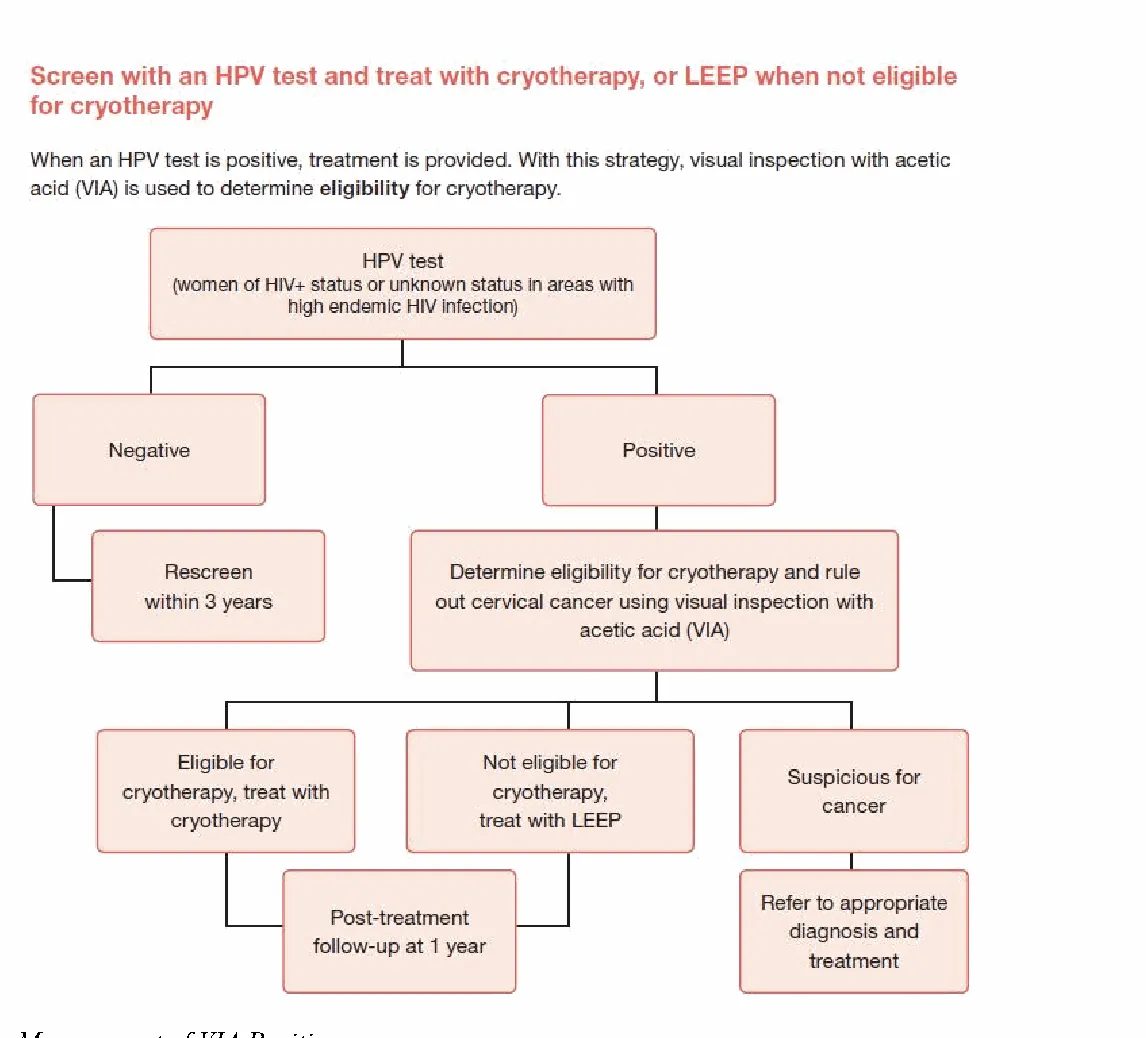
infection of the most common HPV subtypes (see chart below for WHO 2013 screening algorithm when HPV testing is available).
Clinical description
Management of VIA Positive:
- Patient is eligible for cryotherapy if:
- Entire squamocolumnar junction is visible
- Entire lesion is visible and does not extend into the endocervical canal or beyond the cryoprobe
- Lesion covers <75% of ectocervix
After cryotherapy, patient should follow-up after 1 year.
- If patient is not eligible for cryotherapy, loop electrosurgical excision procedure (LEEP) should be done.
- After LEEP, patient should follow-up after 6 weeks to review pathology results.
If result shows CIN1 or less, rescreen within 3 years (1 year if HIV-infected).
If result shows CIN2 or CIN3, rescreen after 1 year.
Management of abnormal pap smear (ASCUS, LSIL, HSIL, malignant cells)
- Colposcopy with directed biopsies +/- endocervical curettage (if no lesions) should be performed
Management of abnormal cervical biopsy results (CIN1, CIN2, CIN3, invasive cancer)
- CIN1: rescreen at1 year
- CIN2: offer cryotherapy or LEEP
- CIN3: offer cryotherapy or LEEP; if HIV-positive, can also offer hysterectomy (preferably vaginal)
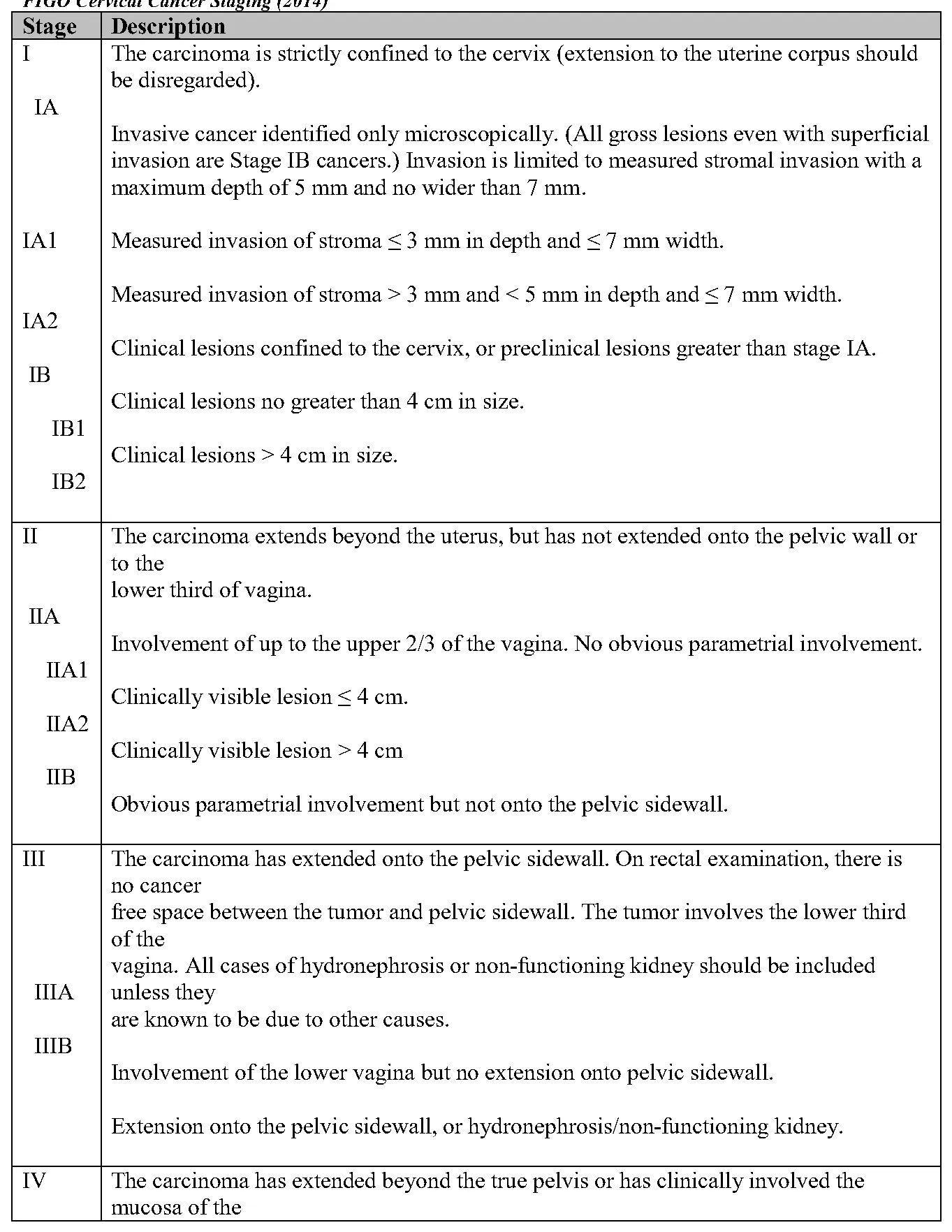
- Invasive cancer: complete FIGO staging
*Note: If patient is pregnant and found to be VIA+, she can have a pap smear done (without endocervical sampling), but should not have cryotherapy, cervical biopsy, or LEEP performed.
If she needs to have any of these procedures performed, she should follow-up 6 week postpartum to have them done.
Clinical description
FIGO Cervical Cancer Staging (2014) Stage Description I The carcinoma is strictly confined to the cervix (extension to the uterine corpus should be disregarded).
IA Invasive cancer identified only microscopically. (All gross lesions even with superficial invasion are Stage IB cancers.) Invasion is limited to measured stromal invasion with a maximum depth of 5 mm and no wider than 7 mm.
IA1 Measured invasion of stroma ≤ 3 mm in depth and ≤ 7 mm width.
Measured invasion of stroma > 3 mm and < 5 mm in depth and ≤ 7 mm width.
IA2 Clinical lesions confined to the cervix, or preclinical lesions greater than stage IA.
IB Clinical lesions no greater than 4 cm in size.
IB1 Clinical lesions > 4 cm in size.
IB2 II The carcinoma extends beyond the uterus, but has not extended onto the pelvic wall or to the lower third of vagina.
IIA Involvement of up to the upper 2/3 of the vagina. No obvious parametrial involvement.
Clinically visible lesion ≤ 4 cm.
Clinically visible lesion > 4 cm IIB Obvious parametrial involvement but not onto the pelvic sidewall.
III The carcinoma has extended onto the pelvic sidewall. On rectal examination, there is no cancer free space between the tumor and pelvic sidewall. The tumor involves the lower third of the vagina. All cases of hydronephrosis or non-functioning kidney should be included IIIA unless they are known to be due to other causes.
Involvement of the lower vagina but no extension onto pelvic sidewall.
Extension onto the pelvic sidewall, or hydronephrosis/non-functioning kidney.
IV The carcinoma has extended beyond the true pelvis or has clinically involved the mucosa of the
Clinical description
bladder and/or rectum.
IVA Spread to adjacent pelvic organs.
IVB Spread to distant organs.
References FIGO staging for carcinoma of the vulva, cervix, and corpus uteri, International Journal of Gynecology and Obstetrics (2014), doi:10.1016/j.ijgo.2014.02.003.
Malawi Standard Treatment Guidelines 5th Edition, 2015.
World Health Organization. WHO guidelines for screening and treatment of precancerous lesions for cervical cancer prevention. World Health Organization 2013; Geneva, Switzerland.
Tables and figures

Check doses against the printed guideline and your clinical judgement before treating a patient. Spotted an error? Report it from the contact links below.
Need this without data?
The app holds every guideline on your device, with calculators, bookmarks and notes.