
4.11
Miscarriage
Obstetrics & Gynaecology Protocols, Version 3.0, 2017. Chapter 4, Gynaecology.
Clinical description
A miscarriage is any pregnancy loss before 28 weeks gestation, the age of viability in Malawi, or with a fetus < 1,000 g. A Miscarriage is a pregnancy loss that occurs spontaneously, whereas an Induced Abortion results from an intervention purposely used to terminate the pregnancy and is higher risk for infection.
Consider miscarriagein any woman of reproductive age with a history of amenorrhea and one or more of the following: bleeding, abdominal pain, partial expulsion of products of conception (POCs), dilated cervix or smaller uterus than expected.
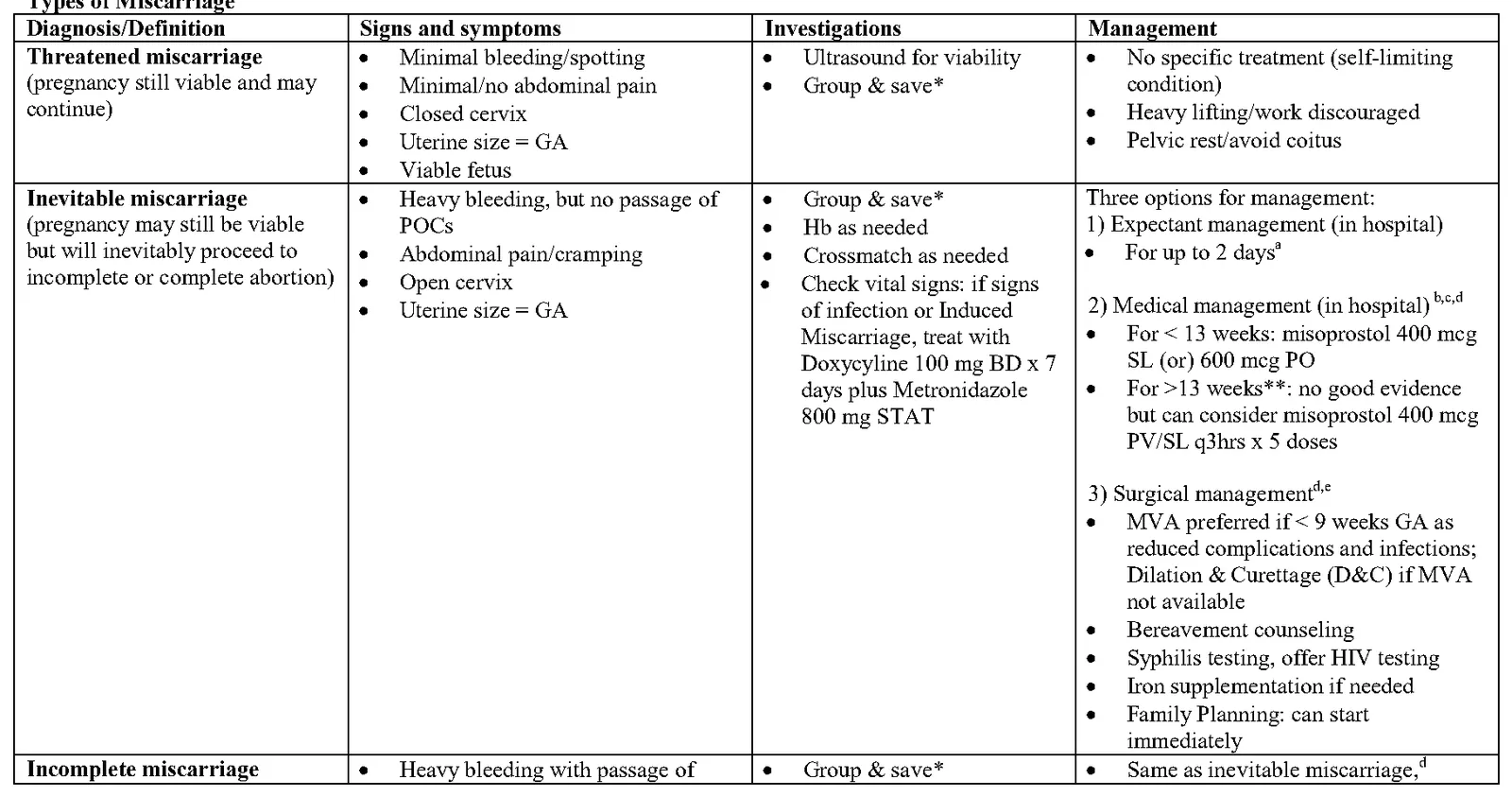
Types of Miscarriage Diagnosis/Definition Signs and symptoms Investigations Management Threatened miscarriage • Minimal bleeding/spotting • Ultrasound for viability • No specific treatment (self-limiting (pregnancy still viable and may • Minimal/no abdominal pain • Group & save* condition) continue) • Closed cervix • Heavy lifting/work discouraged
- Uterine size = GA • Pelvic rest/avoid coitus
- Viable fetus
Inevitable miscarriage • Heavy bleeding, but no passage of • Group & save* Three options for management:
(pregnancy may still be viable POCs • Hb as needed 1) Expectant management (in hospital) but will inevitably proceed to • Abdominal pain/cramping • Crossmatch as needed • For up to 2 daysa incomplete or complete abortion) • Open cervix • Check vital signs: if signs
- Uterine size = GA of infection or Induced 2) Medical management (in hospital) b,c,d
Miscarriage, treat with • For < 13 weeks: misoprostol 400 mcg Doxycyline 100 mg BD x 7 SL (or) 600 mcg PO days plus Metronidazole • For >13 weeks**: no good evidence 800 mg STAT but can consider misoprostol 400 mcg PV/SL q3hrs x 5 doses
- Surgical managementd,e
- MVA preferred if < 9 weeks GA as
reduced complications and infections;
Dilation & Curettage (D&C) if MVA not available
- Bereavement counseling
- Syphilis testing, offer HIV testing
- Iron supplementation if needed
- Family Planning: can start
immediately Incomplete miscarriage • Heavy bleeding with passage of • Group & save* • Same as inevitable miscarriage,d
Clinical description
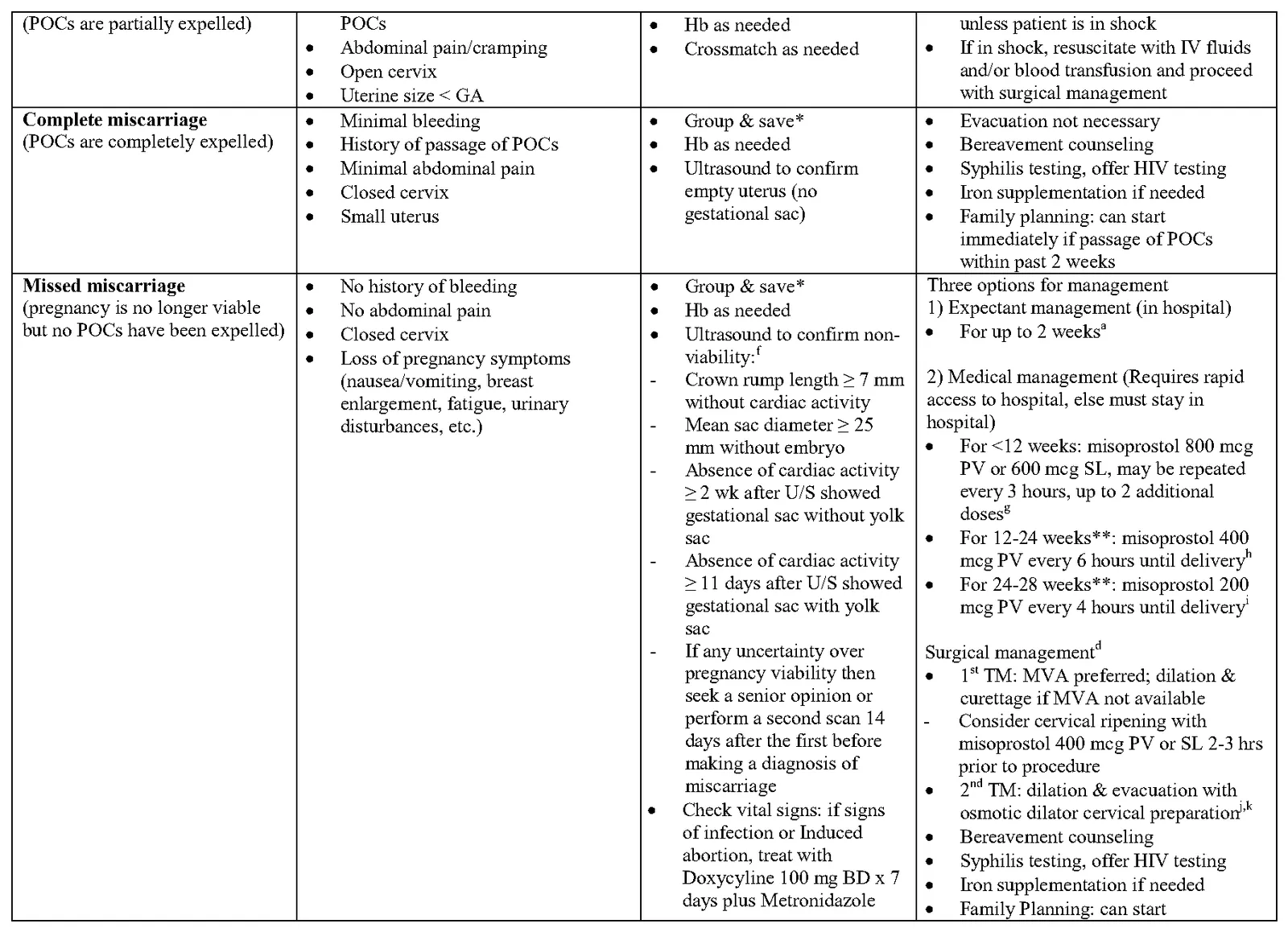
(POCs are partially expelled) POCs • Hb as needed unless patient is in shock
- Abdominal pain/cramping • Crossmatch as needed • If in shock, resuscitate with IV fluids
- Open cervix and/or blood transfusion and proceed
- Uterine size < GA with surgical management
Complete miscarriage • Minimal bleeding • Group & save* • Evacuation not necessary (POCs are completely expelled) • History of passage of POCs • Hb as needed • Bereavement counseling
- Minimal abdominal pain • Ultrasound to confirm • Syphilis testing, offer HIV testing
- Closed cervix empty uterus (no • Iron supplementation if needed
- Small uterus gestational sac) • Family planning: can start
immediately if passage of POCs within past 2 weeks Missed miscarriage • No history of bleeding • Group & save* Three options for management (pregnancy is no longer viable • No abdominal pain • Hb as needed 1) Expectant management (in hospital) but no POCs have been expelled) • Closed cervix • Ultrasound to confirm non- • For up to 2 weeksa
- Loss of pregnancy symptoms viability:f
(nausea/vomiting, breast - Crown rump length ≥ 7 mm 2) Medical management (Requires rapid enlargement, fatigue, urinary without cardiac activity access to hospital, else must stay in disturbances, etc.) - Mean sac diameter ≥ 25 hospital) mm without embryo • For <12 weeks: misoprostol 800 mcg - Absence of cardiac activity PV or 600 mcg SL, may be repeated ≥ 2 wk after U/S showed every 3 hours, up to 2 additional gestational sac without yolk dosesg sac • For 12-24 weeks**: misoprostol 400 - Absence of cardiac activity mcg PV every 6 hours until deliveryh ≥ 11 days after U/S showed • For 24-28 weeks**: misoprostol 200 gestational sac with yolk mcg PV every 4 hours until deliveryi sac - If any uncertainty over Surgical managementd pregnancy viability then • 1st TM: MVA preferred; dilation & seek a senior opinion or curettage if MVA not available perform a second scan 14 - Consider cervical ripening with days after the first before misoprostol 400 mcg PV or SL 2-3 hrs making a diagnosis of prior to procedure miscarriage • 2nd TM: dilation & evacuation with
- Check vital signs: if signs osmotic dilator cervical preparationj,k
of infection or Induced • Bereavement counseling abortion, treat with • Syphilis testing, offer HIV testing Doxycyline 100 mg BD x 7
- Iron supplementation if needed
days plus Metronidazole
- Family Planning: can start
Clinical description
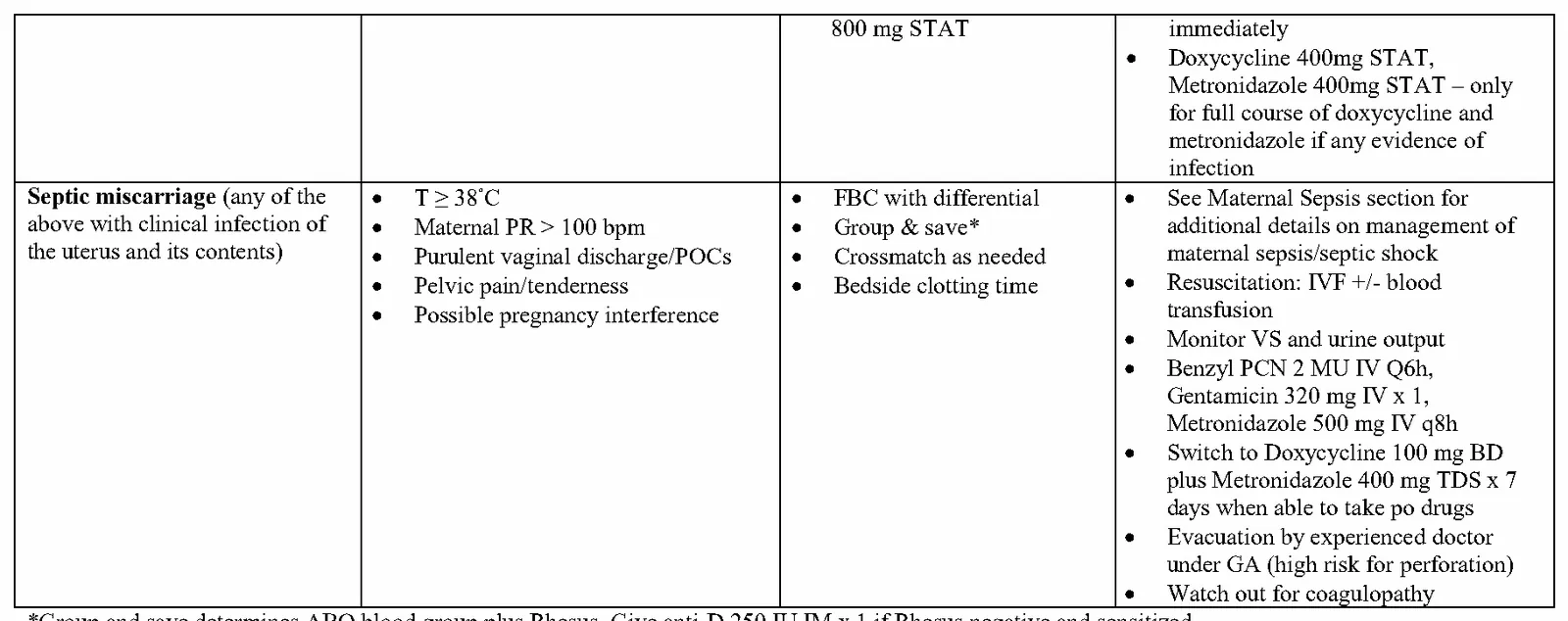
800 mg STAT immediately
- Doxycycline 400mg STAT,
Metronidazole 400mg STAT – only for full course of doxycycline and metronidazole if any evidence of infection Septic miscarriage (any of the • T ≥ 38◦C • FBC with differential • See Maternal Sepsis section for above with clinical infection of • Maternal PR > 100 bpm • Group & save* additional details on management of the uterus and its contents) • Purulent vaginal discharge/POCs • Crossmatch as needed maternal sepsis/septic shock
- Pelvic pain/tenderness • Bedside clotting time • Resuscitation: IVF +/- blood
- Possible pregnancy interference transfusion
- Monitor VS and urine output
- Benzyl PCN 2 MU IV Q6h,
Gentamicin 320 mg IV x 1, Metronidazole 500 mg IV q8h
- Switch to Doxycycline 100 mg BD
plus Metronidazole 400 mg TDS x 7 days when able to take po drugs
- Evacuation by experienced doctor
under GA (high risk for perforation)
- Watch out for coagulopathy
*Group and save determines ABO blood group plus Rhesus. Give anti-D 250 IU IM x 1 if Rhesus negative and sensitized.
**Misoprostol may be used with caution up until 28 weeks GA in women with 1 prior scar; consider using half the recommended dose instead. If more than one prior low transverse caesarean delivery or history of Classical incision, then discuss use of misoprostol of oxytocin with Consultant. Misoprostol should not be given to any woman with a prior scar and gestational age > 28 weeks.l,m References aNanda K, Lopez LM, Grimes DA, et al. Expectant care versus surgical treatment for miscarriage. Cochrane Database of Systematic Reviews 2012, Issue 3. Art.
No.: CD003518.
bNielson JP, Gyte GML, Hickey M, et al. Medical treatments for incomplete miscarriage (less than 24 weeks). Cochrane Database of Systematic Reviews 2010, Issue 1. Art No.: CD007223.
cSociety of Family Planning. Clinical guidelines: labor induction abortion in the second trimester. Contraception 2011;84:4-18.
dKapp N, Whyte P, Tang J, et al. A review of evidence for safe abortion care. Contraception 2012. [Epub ahead of print: Dec 19, 2012.] eTuncalp O, Gulmezoglu AM, Souza JP. Surgical procedures for evacuating incomplete miscarriage. Cochrane Database of Systematic Reviews 2010, Issue 9.
Art No.: CD001993.
fDoubilet P, Benson C, Bourne, et al. Diagnostic criteria for nonviable pregnancy early in the first trimester. NEJM 369(15):1443-51.
gGemzell-Danielsson K, Ho PC, Ponce de León RG, et al. Misoprostol to treat missed abortion in the first trimester. International Journal of Gynecology and Obstetrics 2007;99:S182-5.
hPonce de León RG, Wing DA. Misoprostol for termination of pregnancy with intrauterine fetal demise in the second and third trimester of pregnancy — a systematic review. Contraception 2009:259-71.
Clinical description
iSociety of Family Planning. Interruption of nonviable pregnancies of 24-28 weeks’ gestation using medical methods. Contraception 2013:341-9.
jSociety of Family Planning Cervical preparation for second-trimester surgical abortion prior to 20 weeks’ gestation. Contraception 2014;89:75-84.
kSociety of Family Planning. Cervical preparation for surgical abortion from 20 to 24 weeks’ gestation. Contraception 2008;77:308-14.
lGülec UK, Urunsak IF, Eser E, et al. Misoprostol for midtrimester termination of pregnancy in women with 1 or more prior cesarean deliveries. International Journal of Obstetrics and Gynecology 2013;120:85-7.
mInternational Federation of Gynecology & Obstetrics. Misoprostol Recommended Dosages 2012.
www.misoprostol.org
Tables and figures
Check doses against the printed guideline and your clinical judgement before treating a patient. Spotted an error? Report it from the contact links below.
Need this without data?
The app holds every guideline on your device, with calculators, bookmarks and notes.