2.1
Recognition & Diagnosis of Severe Malaria
Guidelines for the Treatment of Malaria in Malawi, 6th Edition, 2025. Chapter 1, Severe Malaria.
Clinical description
Severe malaria is malaria due to P. falciparum infection that is sufficiently serious to be an immediate threat to life. It is a medical emergency requiring hospitalisation. Most severe malaria occurs in children under 5 years of age.
Some adults are also at risk of severe disease, including:
- Malawians returning from a long stay (at least one year) in a non-malarious country
- Expatriates from non-malarious countries
- Pregnant women
- Splenectomised individuals
- Immunocompromised patients
Although most children with malaria have fever or a history of fever, the fever may be variable in patients who have progressed to severe malaria. Examine children with suspected severe malaria for other conditions (e.g. pneumonia, meningitis) as a possible cause of their symptoms, and manage these accordingly. If severe malaria is diagnosed in the out-patient setting, commence treatment and refer the patient immediately to a hospital for further evaluation and management.
Confirm severe malaria by microscopy, not by mRDT: the HRP2-based mRDT used in Malawi remains positive for up to two weeks after effective treatment, so all suspected severe malaria cases and treatment failures should be confirmed by microscopy.
Signs and symptoms
Clinical manifestations — any one (mostly seen in combination) defines severe malaria
- Respiratory distress (acidotic breathing)
- Impaired level of consciousness (cerebral malaria)
- Repetitive convulsions
- Shock (weak pulse, cold extremities)
- Hypovolaemia
- Spontaneous bleeding (mouth, nose, skin, eyes)
- Pulmonary oedema
- Prostration
- Excessive or persistent vomiting
- Extreme pallor
- Jaundice (yellowish coloration of eyes)
- Little or no urine output (think about acute kidney injury)
- Very dark coloured urine
Laboratory findings suggesting severe malaria
- Severe anaemia: Hb < 5 g/dl (i.e. Hct < 15%)
- Hypoglycaemia: < 2.5 mmol/l (< 45 mg/dl) in children; < 3.8 mmol/l (< 70 mg/dl) in adults
- Hyperlactataemia (lactic acidosis): blood lactate > 4 mmol/l
- Electrolyte imbalance: hyponatraemia < 135 mmol/l
- Acute kidney injury: serum creatinine > 265 µmol/l or > 1.4 mg/dl
- Haemoglobinuria
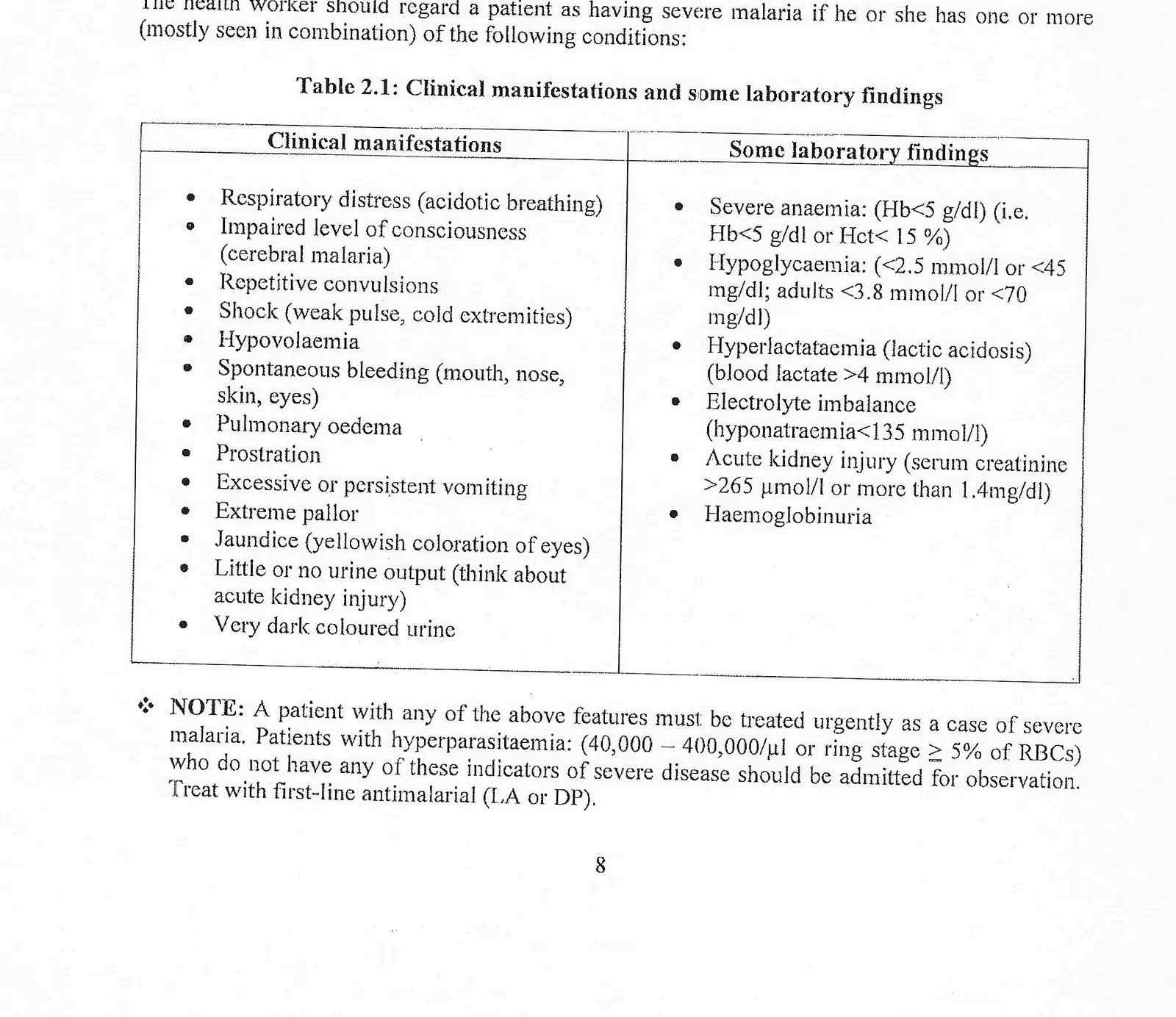
A patient with any of the above features must be treated urgently as a case of severe malaria. Patients with hyperparasitaemia (40 000–400 000/µl or ring stage ≥ 5% of RBCs) who do not have any of these indicators of severe disease should be admitted for observation. Treat with first-line antimalarial (LA or DP).
Check doses against the printed guideline and your clinical judgement before treating a patient. Spotted an error? Report it from the contact links below.
Need this without data?
The app holds every guideline on your device, with calculators, bookmarks and notes.