
18.10.2
Clinical screening and diagnosis of treatment failure
Clinical HIV Guidelines, 5th Edition, 2022. Chapter 18, Continuing ART.
Clinical description
- Suspect ART failure if both of the following clinical conditions are met:
o On ART for at least 12 months o New HIV-related disease / unexplained weight loss / failure to thrive
- For all suspected ART failure cases, look for indications for poor adherence in the last 6 months
o Adherence was good:
- Do a targeted VL, where available use a point-of-care VL testing platform such as
Gene Xpert or refer to have this done immediately.
o Known current poor adherence:
- Start intensive adherence counselling (see page 86)
- Do a targeted VL after 3 months if adherence was satisfactory.
- See Figure 3 on page 95 for the interpretation of VL results.
When to do VL
- See Figure 4 on page 104 for the alignment of the VL monitoring schedule and 6 months dispensing.
Children on paediatric ARV formulations (blue patient card), pregnant and breastfeeding women
- The first VL is scheduled at 6 months after ART initiation or re-initiation. Aim for 6-monthly routine
VL monitoring thereafter. Revert to 12-monthly monitoring when the patient is on adult ARV formulations (yellow cards) and no longer pregnant / breastfeeding.
- Routinely collect the next VL sample when 5 months or more have elapsed since the last VL sample
was collected.
All other patients
- The first VL is scheduled at 6 months after ART initiation or re-initiation. Aim for 12-monthly routine
VL monitoring thereafter.
- Routinely collect the next VL sample when 11 months or more have elapsed since the last VL
sample was collected.
All patient groups
- Don’t delay a scheduled/routine or targeted viral load sample collection because of (suspected)
poor adherence.
- Ascertain good adherence in the last 3 months before taking the follow-up sample after a first high
VL and IAC.
o Review pill count and doses missed carefully.
o Trust the patient if they insist that adherence was good. Do not rely on pill count alone.
- Delay collection of follow-up sample after IAC ONLY if poor adherence is confirmed and if the
patient is still clinically stable.
Interpreting and acting on VL results
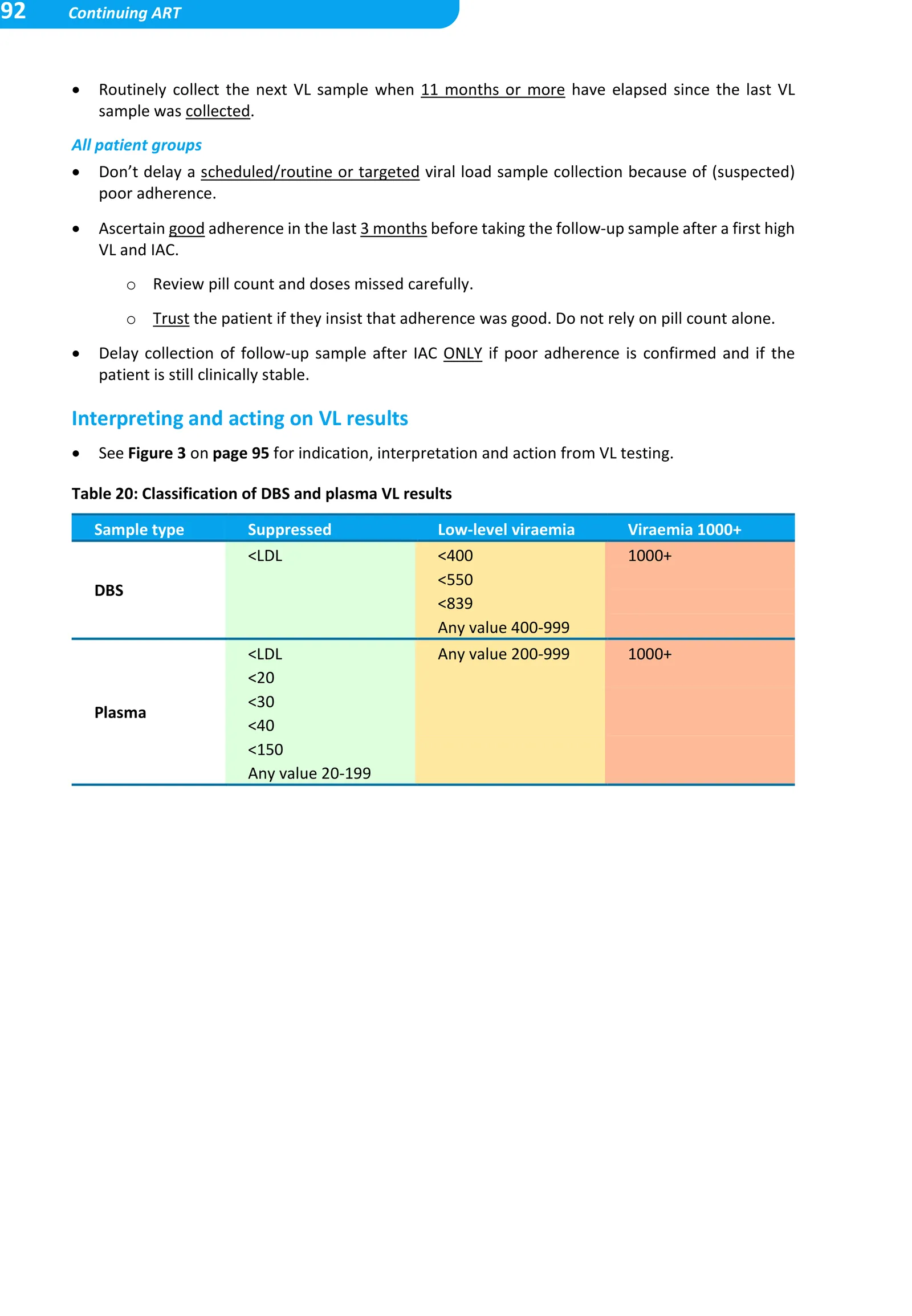
- See Figure 3 on page 95 for indication, interpretation and action from VL testing.
Table 20: Classification of DBS and plasma VL results Sample type Suppressed Low-level viraemia Viraemia 1000+ <LDL <400 1000+ <550 DBS <839 Any value 400-999 <LDL Any value 200-999 1000+ <20 <30 Plasma <40 <150 Any value 20-199 Continuing ART 93 Successful ART Finding Routine or targeted / repeat VL “suppressed” Interpretation Successful ART Action Praise the patient and encourage further good adherence.
Continue the same regimen.
Offer 6 month dispensing if otherwise eligible.
Next routine VL after 6 months for children on paediatric regimens, pregnant and breastfeeding women; after 12 months for all other patients Potential treatment failure Finding Routine, Targeted/ repeat or Follow-up VL: “low-level viraemia” Interpretation Potential treatment failure Action Deliver one quality session of intensive adherence counselling and depression screening (see section 12.4.1 on page 56) at the same visit when returning the result to the patient. Provide additional IAC sessions at 1-month intervals for patients with specific adherence problems.
Enter in “Detectable Viral Load” register (green cover, prev. “High VL register”).
Continue same ART regimen.
Give a regular 3-month appointment.
Collect repeat VL sample after 3 months of good adherence. Collect the next VL after 6 months if follow-up result is still “low-level viraemia”.
Confirmed treatment failure Finding Targeted / repeat VL: “viraemia 1000+” AND Patient is on NNRTI-based regimen (4, 5, 17) AND good adherence in the 3 months before sample collection Interpretation The virus is likely resistant to the current ART regimen.
Action Deliver one quality session of intensive adherence counselling at the same visit when returning the result to the patient. Provide additional IAC sessions at 1- month intervals for patients with specific adherence problems.
Enter in “Detectable Viral Load” register (green cover, prev. “High VL register”).
Consult certified 2nd Line Prescriber for initiation of 2nd line ART without delay.
‘Reset the clock’ for routine VL monitoring: 6 months after switch to 2nd line and every 12 months thereafter.
Poor adherence or treatment failure Finding Targeted / repeat VL: “viraemia 1000+” AND Patient is on PI- or DTG-based regimen (7, 8, 9, 10, 11, 12, 13, 14, 15, 16)
Interpretation High VL on these regimens can be adherence problems / poor absorption or drug- resistant virus. Need HIV drug resistance testing to confirm resistance before changing regimen.
Action Deliver one quality session of intensive adherence counselling at the same visit when returning the result to the patient. Provide additional IAC sessions at 1- month intervals for patients with specific adherence problems.
Enter in “Detectable Viral Load” register (green cover, prev. “High VL register”).
Collect DBS or plasma sample for genotyping.
Continue current regimen until genotyping results are available.
Give a regular 3-month appointment.
Select ART regimen based on resistance profile.
‘Reset the clock’ for routine VL monitoring: 6 months after switch to 2nd or 3rd line and every 12 months thereafter.
Continuing ART 95 Figure 3: Indication, interpretation and action for routine scheduled and targeted VL testing When to do VL ART clinic visit Less than 6 6 Months or more Months Less than 5 or 5 or 11(1) months Never (2)
11(1) months ago ago or more Well Not Well (3)
Routine Wait scheduled Result and Action Low-level viraemia Suppressed or viraemia 1000+ Potential Failure Successful ART Intensive Adh. Continue current Support regimen Targeted/ Follow-up VL Viraemia 1000+ Low-level viraemia Suppressed Af te r 6 m o nt h s 4, 5, 17 7 – 15 NNRTI PI or INSTI Poor adherence or Confirmed Failure Potential Failure Successful ART Failure Intensive Adh. Continue current Start 2nd Line Genotype testing Support regimen (1) For children on paediatric regimens (blue patient card), pregnant and breastfeeding women:
a new VL is scheduled every 6 months after the last test. Use 5-month cut-off for these priority patient groups.
All other patient groups: a new VL is scheduled every 12 months after the last test. Use 11-month cut-off.
(2) Includes: VL never tested, sample rejected, result lost or declared missing (3) Any of the following: Significant weight loss, failure to thrive, new / worsening HIV-related disease (susp. or confirmed)
Check doses against the printed guideline and your clinical judgement before treating a patient. Spotted an error? Report it from the contact links below.
Need this without data?
The app holds every guideline on your device, with calculators, bookmarks and notes.