
11.4
Congenital Syphilis
Guidelines for Management of Sexually Transmitted Infections, 5th Edition, 2025. Chapter 11, STI with Specific Causes.
Clinical description
- 60–90% of infants with congenital syphilis have no signs at birth; signs may appear weeks or months later.
- Early congenital (under 2 years): rash on palms/soles, enlarged liver/spleen, jaundice, bone/joint swelling, snuffles (bloody nasal discharge), failure to thrive, meningitis ± seizures.
- Late congenital (usually age 5–15): Hutchinson's teeth, corneal inflammation, hearing loss, intellectual disability, bone/joint deformities, gummas.
- Transmission in utero; breastfeeding transmission only if open sores on mother's breast.
Treatment
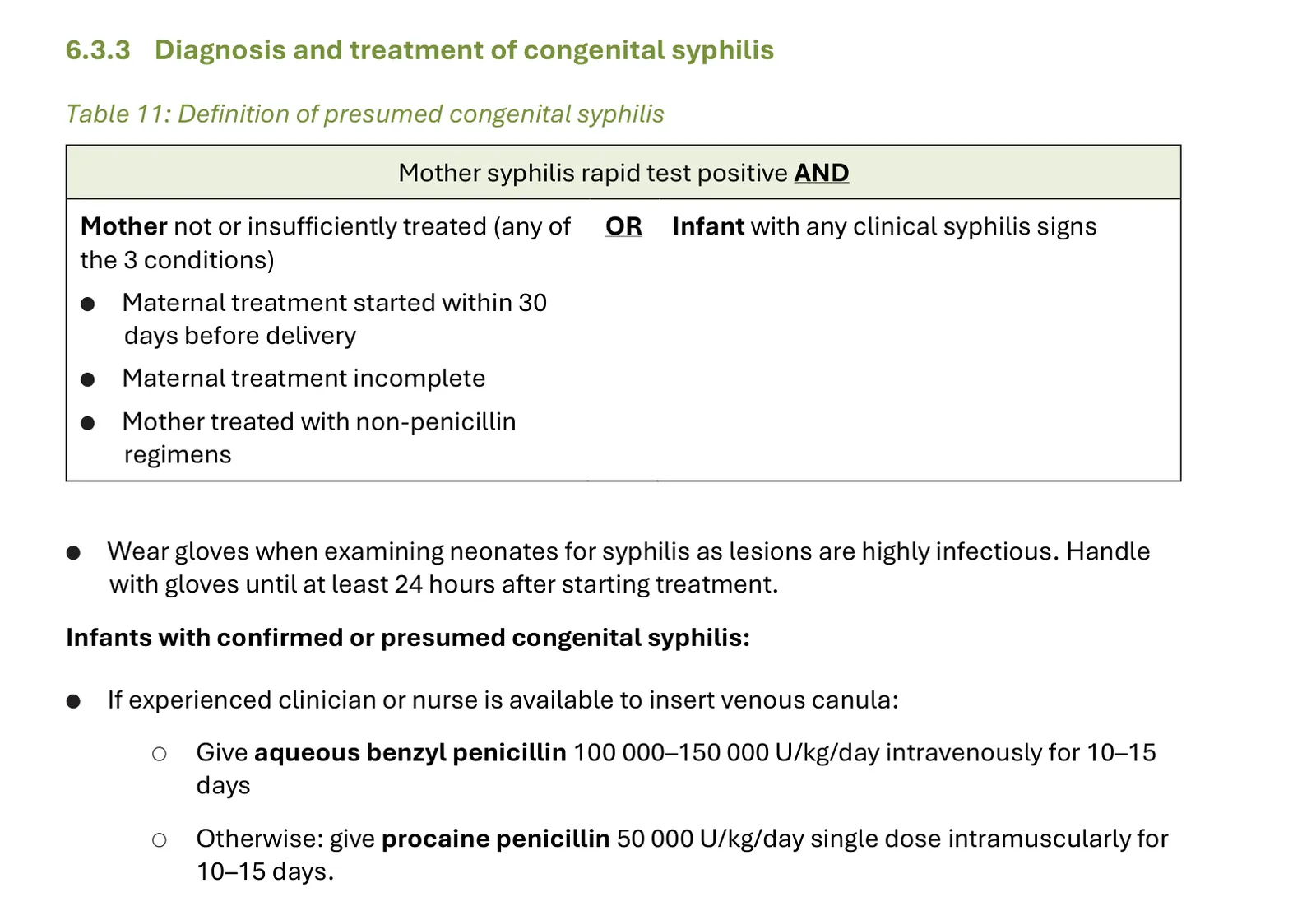
Presumed congenital syphilis: mother syphilis rapid test positive AND mother not/insufficiently treated (treatment started within 30 days of delivery, incomplete, or non-penicillin regimen), OR infant with any clinical syphilis signs. Wear gloves when examining neonates — lesions are highly infectious.
Confirmed or presumed congenital syphilis
- Aqueous benzyl penicillin 100,000–150,000 U/kg/day IV for 10–15 days.
- OR procaine penicillin 50,000 U/kg/day IM OD for 10–15 days.
Expect good response to penicillin but recovery of severely ill infants may take weeks/months. Review infants without signs at 1 and 2 months. A positive syphilis rapid test in a previously untreated child ≥ 12 months old is likely active syphilis — treat as early or late congenital syphilis. Treat the mother and all sexual partners for early or late syphilis.
Tables and figures
Check doses against the printed guideline and your clinical judgement before treating a patient. Spotted an error? Report it from the contact links below.
Need this without data?
The app holds every guideline on your device, with calculators, bookmarks and notes.