
3.6
Diabetes In Pregnancy
Obstetrics & Gynaecology Protocols, Version 3.0, 2017. Chapter 3, Medical Conditions in Pregnancy.
Clinical description
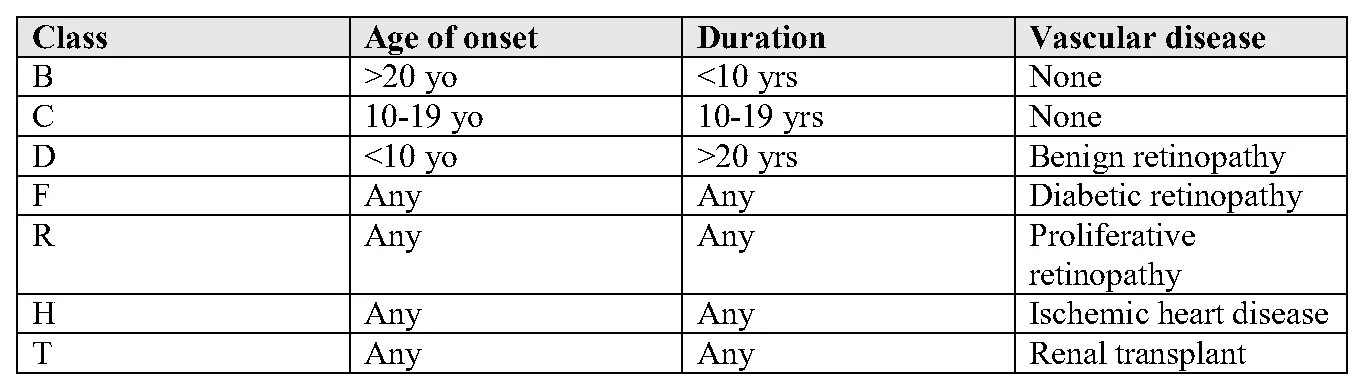
Diabetes mellitus is a group of metabolic diseases characterized by hyperglycaemia resulting from defects in insulin secretion, action or both. It can be gestational or preexisting. A1 refers to gestational diabetes that is controlled with diet and exercise, while A2 requires either oral medication or insulin. If a pregnant woman is diagnosed with overt diabetes requiring treatment at < 20 wks gestation, she has pre-gestational diabetes (class B). White's classification of pre- gestational diabetes is shown in the following table:
Class Age of onset Duration Vascular disease B >20 yo <10 yrs None C 10-19 yo 10-19 yrs None D <10 yo >20 yrs Benign retinopathy F Any Any Diabetic retinopathy R Any Any Proliferative retinopathy H Any Any Ischemic heart disease T Any Any Renal transplant Maternal risks in preexisting diabetes Fetal risks Diabetic ketoacidosis Congenital anomalies Retinopathy Early pregnancy losses Nephropathy Preterm labor Hypertension Increased perinatal mortality Infection Shoulder dystocia and birth trauma Operative delivery Pelvic floor trauma Diagnosis- screening of all high risk patients in pregnancy. Risk factors include family history of diabetes, diabetes in previous pregnancy, previous IUFD, previous macrosomic (> 4,000g) infant, BMI > 30 kg/m2.
Exam/ Investigations
- Send blood for fasting blood sugar (FBS) or random blood sugar (RBS)
- FBS > 7.0 mmol/L is suspicious for diabetes
- FBS > 7.0 x 2 or FBS > 11.0 mmol/L confirms diabetes; no oral glucose tolerance test (OGTT)
needed
- RBS > 11.1 mmol/L is suspicious for diabetes
- Send blood for OGTT at 24-30 wks gestation
- Procedure: FBS is drawn, woman drinks 75 g glucose load and serum glucose is drawn 1 hr and 2
hrs later Abnormal values: FBS > 7 mmol/L (126mg/dl), 2 hour blood sugar (BS) >7.8 mmol/L (140mg/dl) Gestational diabetes
- Initial management: trial of diet and exercise for 2-4 wks
- Nutrition counseling
- Patient should self-record daily blood glucose levels before each meal and before going to bed
- Treat with oral hypoglycaemic for FBS > 8 mmol/L x 2 or more
- Goal is to maintain FBS at 6-8 mmol/L
- Medication-based management
Clinical description
- Metformin (500 mg BID, increase weekly as needed to maximum of 3,000 mg/day) and/or
Glibeclamide (2.5 mg PO BD, increase weekly as needed to maximum of 20mg/day)
- Send blood for FBS or check FBS with glucometer twice weekly
- Switch to Insulin for persistent FBS > 8 mmol/L despite maximum dose of Metformin &
Glibeclamide
- Refer to medicine clinic at 12 wks postnatal due to increased risk of long-term diabetes
Insulin-requiring diabetes (gestational and pre-gestational)
- For pre-gestational diabetics, continue pre-pregnancy regimen if blood sugaris controlled.
- For women who never used a glucometer before, consider inpatientadmission for diabetic education and
glucose control.
- Antenatal care visits: every 2 wks until 30 wks gestation, then weekly untildelivery
- American Diabetic Association diet at 30-35 kcal/kg/day; increase caloriesfor normoglycemic ketonuria
- Patient logbook to self-record daily insulin dosages and daily blood glucose levels at 7hrs, 11hrs, 16hrs and
21hrs
- Initial insulin is calculated based on maternal weight
- In first trimester, total daily dose = weight x 0.7 units
- In second trimester, total daily dose = weight x 0.8 units
- In third trimester, total daily dose = weight x 0.9-1.0 units
- Given as 2/3 of total daily dose in the morning at breakfast: 1/3 assoluble Insulin and 2/3 as long-
acting Insulin
- Given as 1/3 of total daily dose in the evening at dinner (17hrs): 1/2 assoluble Insulin and 1/2 as
long-acting Insulin
- For example, for weight of 72 kg in third trimester, give 16 units solubleInsulin and 32 units long-
acting Insulin at breakfast and 12 units solubleInsulin and 12 units long-acting Insulin at dinner
- Goal blood glucose levels: FBS < 6 mmol/L, other BS 6-8 mmol/L
Pregestational Diabetes
- Comprehensive US at 18-20 wks gestation for fetal structural defects
- Baseline maternal ophthalmology exam for diabetic retinopathy
- Baseline serum creatinine for diabetic nephropathy renal disease
- Send urine mcs every trimester
- Fetal surveillance (kick counts and/or biophysical profile (BPP) weekly) at 34wks gestation until delivery
- Start at 28 wks gestation for Class D and higher, IUGR or coexistenthypertension (HTN)
- Hospitalization at 34-36 weeks
- Intrapartum management
- No specific treatment if labour progresses normally and quickly
- For induction or prolonged labour: add 1/3 of her daily insulin as solubleInsulin to 1 L of DNS
and treat at 40 dpm
- For Caesarean: skip AM Insulin, start DNS
- Place Oxytocin in separate bag of NS fluid using separate IV access
- Delivery
- At 39 wks gestation for women with well-controlled blood sugars andno vascular disease
- At earlier gestation (37-38wks) for Class D and higher, polyhydramnios,macrosomia, poor blood
glucose control, chronic HTN on medication orIUGR
- Caesarean delivery for EFW > 4500g on US
Postnatal period (insulin needs drop rapidly)
- Breastfeed infant early and notify paediatricians of maternal diabetes
- Use insulin sliding scale for 5 days post vaginal delivery and then resumepre-pregnancy regimen
- Treat with DNS at 3L daily post Caesarean delivery until tolerating PO andthen use insulin sliding scale
- Insulin sliding scale based on blood glucose drawn 1 hr after meals
- Blood Glucose: Insulin dose
- 0-5 mmol/L: None
- 5-8 mmol/L: 4 units soluble
Clinical description
- 8-12 mmol/L: 8 units soluble
- 12-16 mmol/L: 12 units soluble
- 16-20 mmol/L: 16 units soluble
Diabetic ketoacidosis
- Often triggered by an infection
- Very severe condition that requires prompt diagnosis and treatment toavoid morbidity and mortality
- Presents with nausea and vomiting, thirst, polyuria, polydipsia, alteredmental status, either known history
of diabetes or not
- Exam is significant for tachycardia, tachypnoea, fruity breath (due toketones)
- Do point-of-care urinalysis for ketones and/or leukocytes
- Check RBS every 1-2 hours if possible
- Send blood for FBC with differential
- Send urine mcs
- Management based on reducing blood glucose in controlled manner
- On admission: NS 1L over 30 min Soluble insulin 20units IV STATfollowed by soluble insulin
12-20 units IM every 2hours Add 20 mmol KCl to first litre of NS Monitor K and anion gap every1-2 hours until stable if available
- Next 2 hours NS 1L over 1 hourx 2 L
- Next 4 hours NS 1⁄2 L over hour x2 L
- RBS < 12 mmol/L DNS Insulin sliding scale
Tables and figures
Check doses against the printed guideline and your clinical judgement before treating a patient. Spotted an error? Report it from the contact links below.
Need this without data?
The app holds every guideline on your device, with calculators, bookmarks and notes.