
7
WHO Clinical Staging
Clinical HIV Guidelines, 5th Edition, 2022. Chapter 7, WHO Clinical Staging.
Clinical description
- Untreated HIV infection leads to a gradual destruction of the immune system.
- Different HIV-related diseases appear at different levels of immune suppression.
- Most of these diseases can also occur in HIV negative patients, but they are a lot more common
and more severe in HIV infected patients.
- Actively search for and treat HIV-related diseases at ART initiation and at every follow-up visit.
ART alone may not save the patient.
- Patients may have several HIV-related diseases at the same time. Write all diseases found on
the ART Patient Card.
- HIV-related diseases are grouped into 4 WHO clinical stages that correlate with disease
progression and prognosis of survival:
o Stage 1: Asymptomatic o Stage 2: Mild o Stage 3: Advanced o Stage 4: Severe
- Many patients have several HIV-related diseases from different stages.
o List all conditions on the ART Patient Card.
o The most severe condition determines the WHO clinical stage.
- Most WHO stage defining conditions apply to all ages, but some stage-defining conditions are
specific to children under 15 years and others are specific to adults.
- WHO clinical staging requires confirmed HIV infection.
- An infant aged under 12 months with only a positive HIV rapid antibody test can NOT be given
a WHO clinical stage because HIV antibodies in infants do not confirm HIV infection.
o However, an infant with HIV antibodies and specific clinical conditions is very likely to have AIDS and needs to start ART without delay (see definition of Presumed Severe HIV Disease below).
- WHO clinical staging remains critical for identifying patients with advanced HIV disease and for
general clinical care
- WHO clinical staging is mandatory for all HIV patients, regardless of CD4 count availability.
- Complete staging for every new HIV patient.
Table:5 WHO clinical staging for children and adults with confirmed HIV infection and definition of presumed severe HIV disease for infants Adults and Children Adults only (15 years or older) Children only (below 15 years)
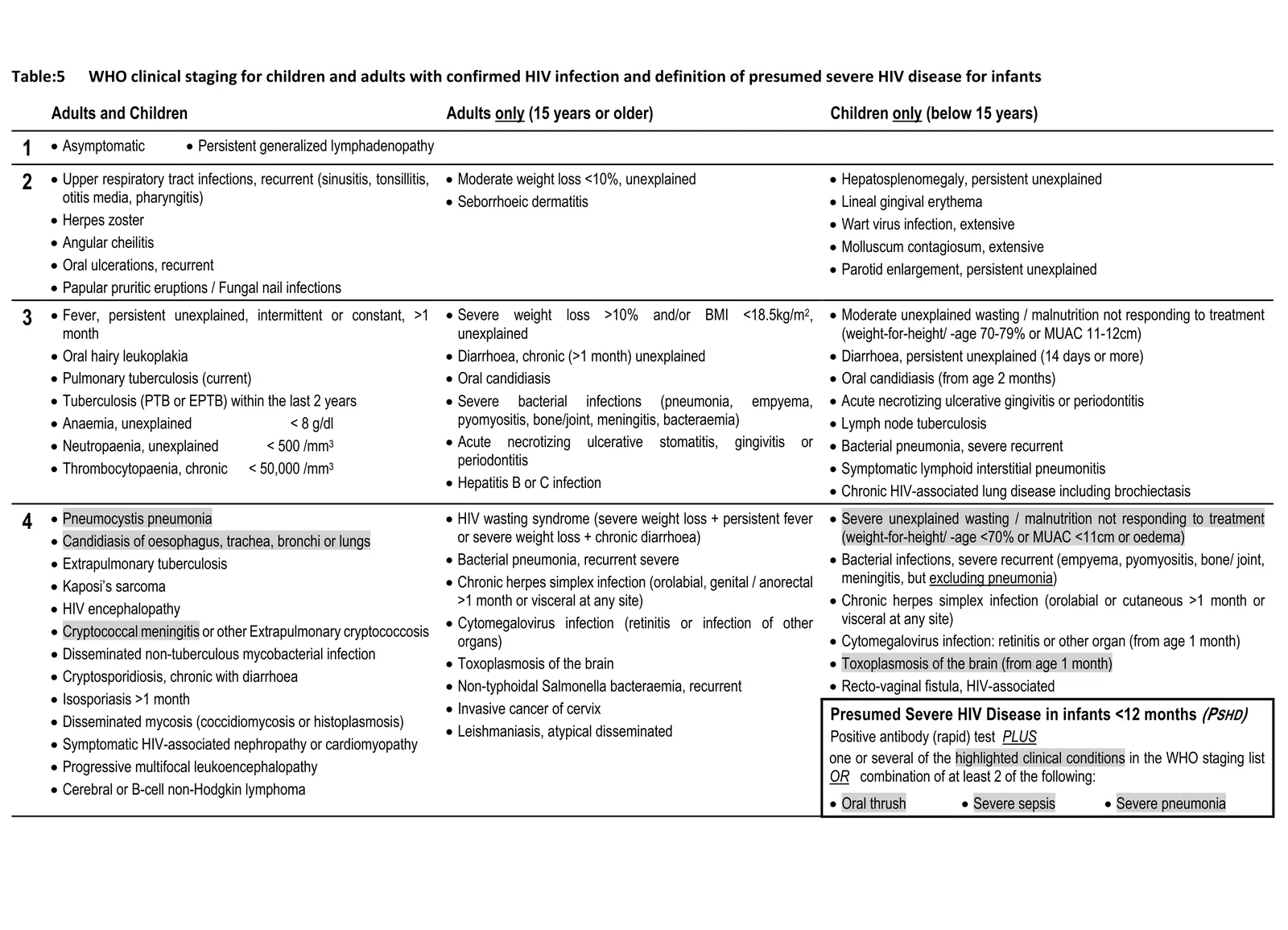
1 • Asymptomatic • Persistent generalized lymphadenopathy 2 • Upper respiratory tract infections, recurrent (sinusitis, tonsillitis, • Moderate weight loss <10%, unexplained • Hepatosplenomegaly, persistent unexplained otitis media, pharyngitis) • Seborrhoeic dermatitis • Lineal gingival erythema
- Herpes zoster • Wart virus infection, extensive
- Angular cheilitis • Molluscum contagiosum, extensive
- Oral ulcerations, recurrent • Parotid enlargement, persistent unexplained
- Papular pruritic eruptions / Fungal nail infections
3 • Fever, persistent unexplained, intermittent or constant, >1 • Severe weight loss >10% and/or BMI <18.5kg/m2, • Moderate unexplained wasting / malnutrition not responding to treatment month unexplained (weight-for-height/ -age 70-79% or MUAC 11-12cm)
- Oral hairy leukoplakia • Diarrhoea, chronic (>1 month) unexplained • Diarrhoea, persistent unexplained (14 days or more)
- Pulmonary tuberculosis (current) • Oral candidiasis • Oral candidiasis (from age 2 months)
- Tuberculosis (PTB or EPTB) within the last 2 years • Severe bacterial infections (pneumonia, empyema, • Acute necrotizing ulcerative gingivitis or periodontitis
- Anaemia, unexplained < 8 g/dl pyomyositis, bone/joint, meningitis, bacteraemia) • Lymph node tuberculosis
- Neutropaenia, unexplained < 500 /mm3 • Acute necrotizing ulcerative stomatitis, gingivitis or • Bacterial pneumonia, severe recurrent
periodontitis
- Thrombocytopaenia, chronic < 50,000 /mm3 • Symptomatic lymphoid interstitial pneumonitis
- Hepatitis B or C infection
- Chronic HIV-associated lung disease including brochiectasis
4 • Pneumocystis pneumonia • HIV wasting syndrome (severe weight loss + persistent fever • Severe unexplained wasting / malnutrition not responding to treatment
- Candidiasis of oesophagus, trachea, bronchi or lungs or severe weight loss + chronic diarrhoea) (weight-for-height/ -age <70% or MUAC <11cm or oedema)
- Extrapulmonary tuberculosis • Bacterial pneumonia, recurrent severe • Bacterial infections, severe recurrent (empyema, pyomyositis, bone/ joint,
- Chronic herpes simplex infection (orolabial, genital / anorectal meningitis, but excluding pneumonia)
- Kaposi’s sarcoma
>1 month or visceral at any site) • Chronic herpes simplex infection (orolabial or cutaneous >1 month or
- HIV encephalopathy
- Cytomegalovirus infection (retinitis or infection of other visceral at any site)
- Cryptococcal meningitis or other Extrapulmonary cryptococcosis
organs) • Cytomegalovirus infection: retinitis or other organ (from age 1 month)
- Disseminated non-tuberculous mycobacterial infection
- Toxoplasmosis of the brain • Toxoplasmosis of the brain (from age 1 month)
- Cryptosporidiosis, chronic with diarrhoea
- Non-typhoidal Salmonella bacteraemia, recurrent • Recto-vaginal fistula, HIV-associated
- Isosporiasis >1 month
- Invasive cancer of cervix Presumed Severe HIV Disease in infants <12 months (PSHD)
- Disseminated mycosis (coccidiomycosis or histoplasmosis)
- Leishmaniasis, atypical disseminated Positive antibody (rapid) test PLUS
- Symptomatic HIV-associated nephropathy or cardiomyopathy
one or several of the highlighted clinical conditions in the WHO staging list
- Progressive multifocal leukoencephalopathy
OR combination of at least 2 of the following:
- Cerebral or B-cell non-Hodgkin lymphoma
- Oral thrush • Severe sepsis • Severe pneumonia
Check doses against the printed guideline and your clinical judgement before treating a patient. Spotted an error? Report it from the contact links below.
Need this without data?
The app holds every guideline on your device, with calculators, bookmarks and notes.