23
Post exposure prophylaxis (PEP)
Clinical HIV Guidelines, 5th Edition, 2022. Chapter 23, Post exposure prophylaxis (PEP).
Clinical description
- HIV infection can be prevented after a high-risk contact with fluids from an HIV infected
person.
o Remove immediately as much as possible of the body fluid.
o Immediately give a 30-day supply of PEP and start taking it as soon as possible.
o Assess risk and test for HIV as soon as possible. Continue a 30-day course of ARV prophylaxis (PEP) if exposure is classified as ‘risk’ and exposed person is HIV negative.
- PEP, if taken correctly, reduces the risk of infection by 80%.
- ARVs taken for PEP are usually well tolerated.
- Keep ARVs for PEP accessible 24/7, e.g., at maternity or other well-advertised locations.
- Offer STI treatment and emergency contraception, for rape victims accessing PEP.
- The risk of getting infected may be high or low, depending on the type of substance and
contact. However, PEP should always be started if there is a possible risk of transmission (see classification in Table 23 on page 113).
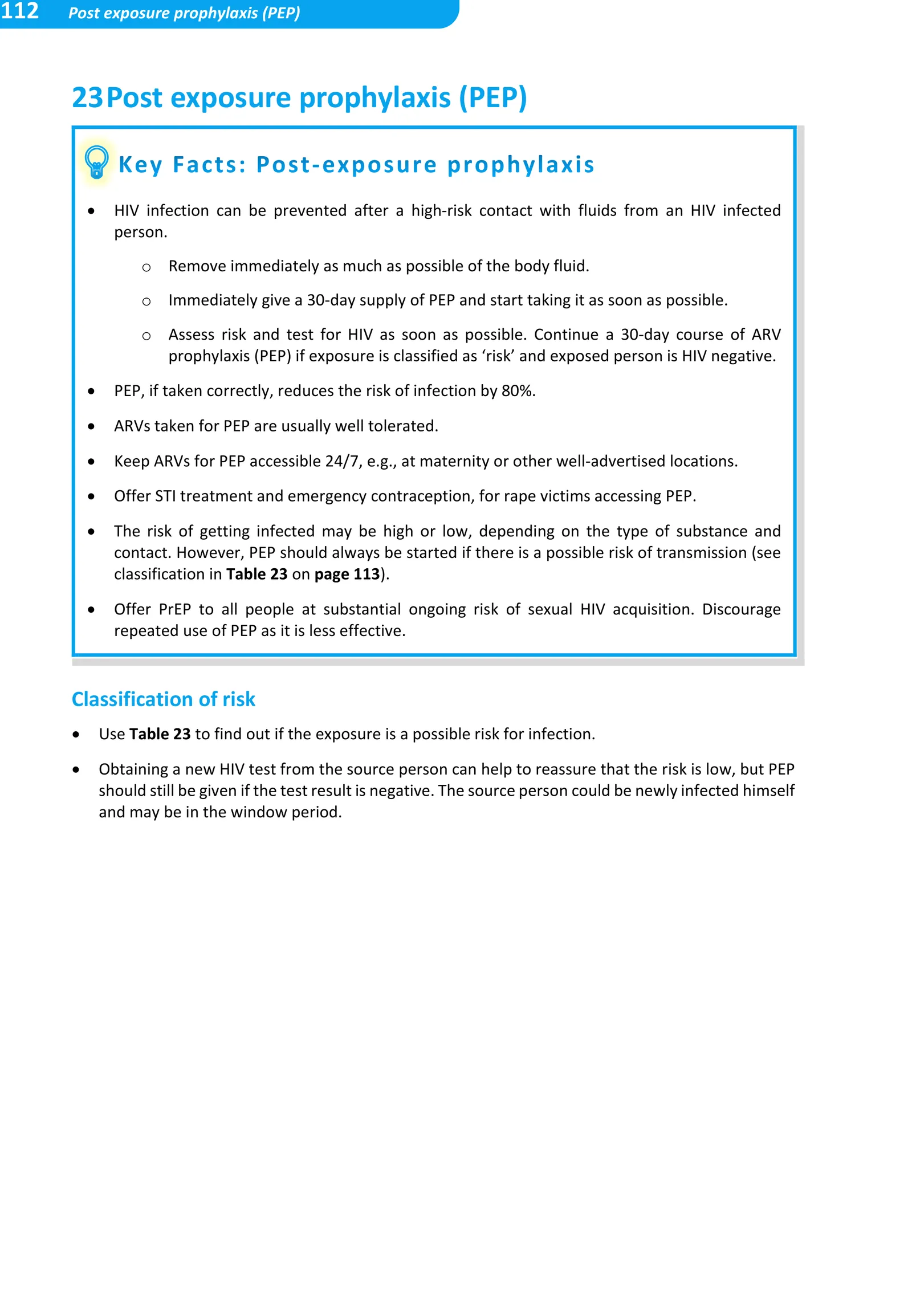
- Offer PrEP to all people at substantial ongoing risk of sexual HIV acquisition. Discourage
repeated use of PEP as it is less effective.
Classification of risk
- Use Table 23 to find out if the exposure is a possible risk for infection.
- Obtaining a new HIV test from the source person can help to reassure that the risk is low, but PEP
should still be given if the test result is negative. The source person could be newly infected himself and may be in the window period.
Post exposure prophylaxis (PEP) 113 Table 23: Classification of risk of transmission after exposure to HIV Substance Type of contact Source person
- Blood • Skin penetrated with contaminated needle • Regardless of
- Semen (hollow or non-hollow) known/unknown HIV
- Vaginal fluid • Large amount of substance on mucous status
- Cerebral-spinal membrane
Risk fluid • Sexual intercourse no condom
- Pleural fluid • Risk substance on lacerated skin / open
- Amniotic fluid
wound
- Synovial fluid
- Ascites fluid
- Urine • Risk substance on intact skin
- Stool
No Risk
- Pus
- Tears
- Saliva
- Sputum
- Nasal secretions
Immediate measures
- Remove infectious substance.
o Wash exposed wounds and skin sites thoroughly with soap.
o Flush mucous membranes with water.
o Do not use bleach, antiseptics or other caustic substances.
Eligibility to start PEP (ARV prophylaxis)
- Any exposure classified as risk in the last 72 hours (see Table 23).
- Never refuse PEP on moral judgement about the kind of exposure (accident, negligence, rape,
‘burst condom’).
- New HIV test is mandatory to confirm negative HIV status,
o BUT: Don’t delay starting PEP if HIV testing is not immediately available (no test kits, night, etc.). Do HIV testing as soon as possible.
- PEP is safe in pregnancy and breastfeeding.
- Severe anaemia (<8g/dl) is contraindication for AZT/3TC.
- Severe renal failure is contraindication TDF/3TC.
How to start PEP
- Start taking PEP as soon as possible after high-risk exposure, ideally within 2 hours.
- Starting PEP more than 72 hours after exposure is not effective and should not be done.
o However, still perform HIV testing at baseline, at 3 and 6 months.
- Explain dosage and importance of adherence.
- Mild side effects (nausea, etc.) are not a reason to stop PEP.
114 Post exposure prophylaxis (PEP)
- Advise to return immediately if serious side effects are suspected.
- Advise all exposed adults to practice safe sex until confirmed HIV negative at 3 months.
o Give 30 condoms and re-supply as requested.
- Do not stop breastfeeding.
- Write case details in PEP register (improvised).
Table 24: Post exposure prophylaxis regimens Weight Standard Alternative 3.0 – 19.9 kg 15PP: ABC 120mg / 3TC 60mg + DTG 10mg AZT 60mg / 3TC 30mg 20 – 24.9 kg 15PA: ABC 120mg / 3TC 60mg + DTG 50mg AZT 60mg / 3TC 30mg 25 – 29.9 kg 15A: ABC 600mg / 3TC 300mg + DTG 50mg AZT 300mg / 3TC 150mg ≥ 30.0 kg 13A: TDF 300mg / 3TC 300mg / DTG 50mg AZT 300mg / 3TC 150mg
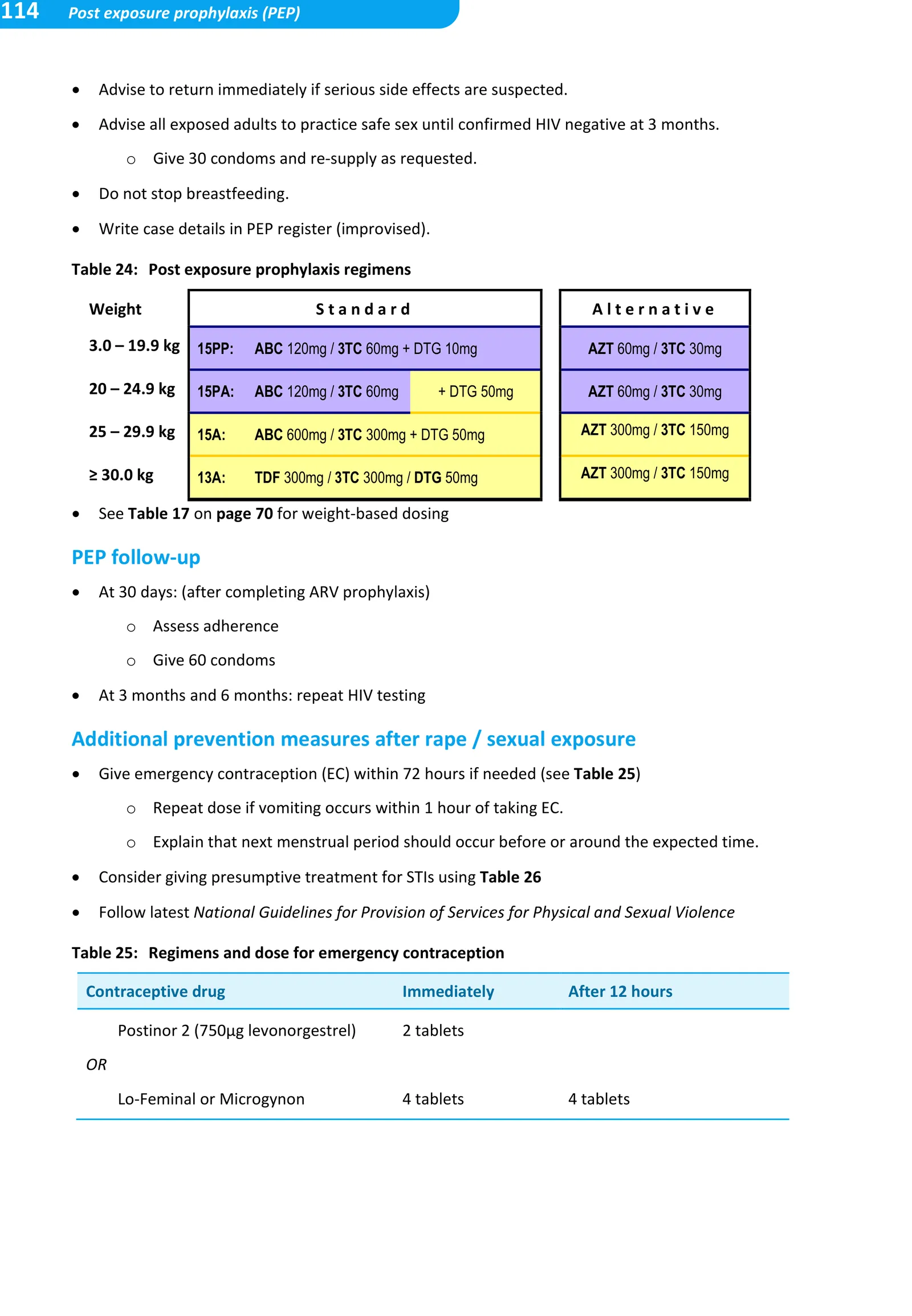
- See Table 17 on page 70 for weight-based dosing
PEP follow-up
- At 30 days: (after completing ARV prophylaxis)
o Assess adherence o Give 60 condoms
- At 3 months and 6 months: repeat HIV testing
Additional prevention measures after rape / sexual exposure
- Give emergency contraception (EC) within 72 hours if needed (see Table 25)
o Repeat dose if vomiting occurs within 1 hour of taking EC.
o Explain that next menstrual period should occur before or around the expected time.
- Consider giving presumptive treatment for STIs using Table
- Follow latest National Guidelines for Provision of Services for Physical and Sexual Violence
Table 25: Regimens and dose for emergency contraception Contraceptive drug Immediately After 12 hours Postinor 2 (750μg levonorgestrel) 2 tablets OR Lo-Feminal or Microgynon 4 tablets 4 tablets Post exposure prophylaxis (PEP) 115 Table 26: Dosing of standard presumptive STI treatment after sexual exposure STI drug Child <15 years Adult Benzathine pen. vials 50,000 IU/kg IM stat (max 2.4 million IU) 2.4 Mega Units IM stat Gentamicin vials 7.5 mg/kg IM stat (max 240mg) 240mg IM stat Erythromycin tabs 12.5 mg/kg 6-hourly for 14 days (max 500 500mg 6-hourly for 7 days mg per dose)
Metronidazole tabs 5 mg/kg 8-hourly for 7 days (max 2 g per 2g stat day)
Nystatin pessaries N/A 100,000 units 12 hourly for 7 days 116 Pharmacovigilance
Check doses against the printed guideline and your clinical judgement before treating a patient. Spotted an error? Report it from the contact links below.
Need this without data?
The app holds every guideline on your device, with calculators, bookmarks and notes.